Watching live television or using BBC iPlayer without a licence is a criminal offence, and the letters TV Licensing sends make sure you know it. What they leave out is almost everything else: how the letters are actually generated, what a visit can and cannot involve, how a prosecution really works, and what a fine actually costs once a court has looked at your income rather than the maximum figure printed on every warning.
This guide to TV licence enforcement covers the whole process honestly, in the order it usually happens. If you watch live television or iPlayer, the straightforward advice is to buy a licence, because it costs far less than a fine. If you genuinely do not need one, the rest of this page tells you exactly where you stand.
Is It Really a Criminal Offence?
Yes. Under the Communications Act 2003, using a television receiver to watch or record programmes as they are broadcast, or to access BBC iPlayer in any way, without a valid licence is a criminal offence. The maximum penalty is a fine of £1,000, plus court costs and the price of the licence itself. TV Licensing, the organisation that collects the fee and pursues non-payment, is run under contract by Capita on behalf of the BBC. It is not a government department and its enforcement officers are not police officers, though the offence itself is prosecuted through the criminal courts.
That maximum figure of £1,000 is the number every letter leads with, and it is also almost never the number anyone actually pays. TV licence enforcement in practice relies far more on real fines worked out from your income than on the headline maximum, and the section below on court outcomes explains exactly how that calculation works.
The Letters: What They Are and Are Not
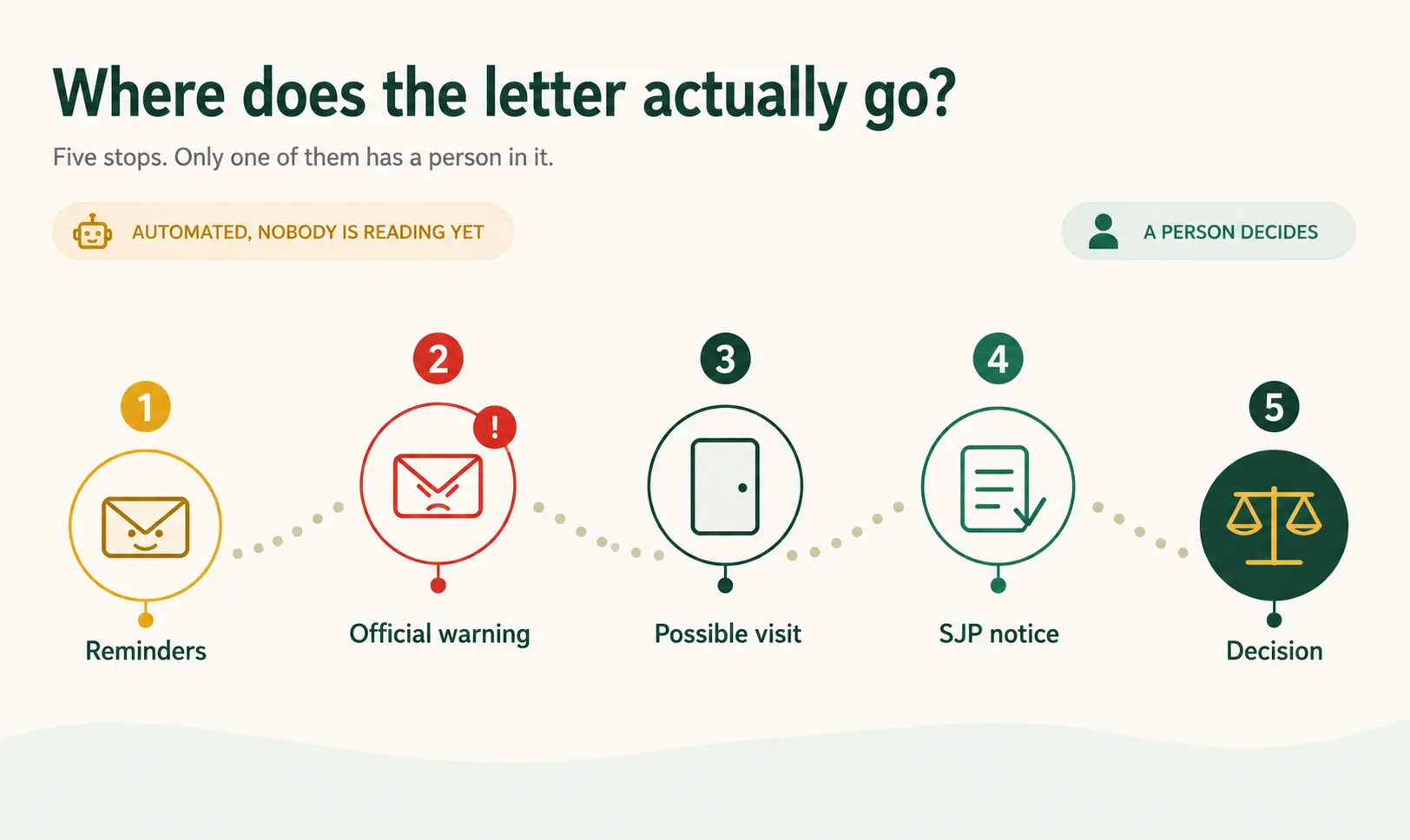
If TV Licensing believes an address is unlicensed, it sends a sequence of letters that grows steadily more serious in tone, from a plain reminder through to an official warning printed in red. Every one of these letters is generated automatically by a database that flags any address without a registered licence. Nobody has reviewed your specific circumstances at this stage. The letters are designed to sound personal and urgent, and they work, which is exactly why so many people pay for a licence they may not actually need rather than risk ignoring one.
If you genuinely do not need a licence, the fastest way to stop this cycle is to complete the No Licence Needed declaration on the TV Licensing website, which pauses standard letters for two years. A full breakdown of every letter in the sequence, including what each one legally does and does not commit you to, is covered in the letter decoder guide.
If an Officer Visits Your Home
If the letters go unanswered, TV Licensing may send an enforcement officer to the property. This is where most people’s understanding of their rights is weakest, and where TV Licensing’s own language does the most work to make a voluntary visit feel compulsory.
What an officer can do
What an officer cannot do
If an officer does interview you, whether on the doorstep or inside, they are required to caution you first, in essentially the same terms the police use: anything you say may be used as evidence. What you say is written onto a document called a Record of Interview, and you will be asked to sign it. That signature matters enormously. If you are ever prosecuted, the Record of Interview is usually the single most important piece of evidence TV Licensing relies on. Do not sign it if any part is incomplete, and do not sign it if you disagree with anything written on it. You are allowed to add anything relevant yourself, including any health, financial or personal circumstances that might be taken into account later.
You are under no obligation to let an officer inside, to answer any question, or to continue a conversation you no longer want to have. A polite “I don’t wish to discuss this” followed by closing the door ends the visit. Nothing about refusing entry or declining to answer questions is itself an offence, whatever the tone of the conversation suggests.
Search Warrants: How Rare They Really Are
Search warrants are the part of TV licence enforcement people worry about most, and they are also the least common part of it by far. A warrant is the only way an officer can lawfully enter your home without your permission, and it is far less common than the letters imply. Under section 366 of the Communications Act 2003, TV Licensing must apply to a magistrate and show genuine evidence that an offence is likely being committed. Simply refusing entry, or being unresponsive to letters, is not on its own enough to justify a warrant. Figures released under Freedom of Information requests give a sense of the real scale: in one recent year, TV Licensing applied for 256 warrants, magistrates granted 167 of them, and only 115 were actually carried out, against a backdrop of millions of unlicensed addresses on their records. Warrants that are granted usually get executed by at least two officers, and TV Licensing’s own policy is generally accompanied by police, mainly to keep the visit calm rather than because the law requires it.
Even with a warrant, TV Licensing’s stated policy is never to force entry. If nobody answers, or entry is refused even at that stage, officers do not break in. A warrant simply removes the legal barrier to entering if you do let them in; it does not give them the power to enter regardless of your response.
Scotland works differently and is worth a separate mention, since most guidance online assumes England and Wales. In Scotland, warrants are issued by a sheriff rather than a magistrate, and in practice they are almost never sought or granted for TV licence cases at all. Prosecutions that do go ahead follow Scotland’s summary procedure through the Sheriff Court or Justice of the Peace Court, a different track from the Single Justice Procedure used south of the border.
Detector Vans and How Cases Are Actually Built
TV Licensing still refers to detector vans in its public messaging, and the vans are real, but what they can actually detect from a modern streaming setup is something TV Licensing has always kept deliberately vague. Whatever their technical capability, detection evidence is very rarely what a prosecution is actually built on. Almost every conviction traces back to a signed Record of Interview: a resident who let an officer in, admitted to watching live television or iPlayer, and put their name to a document confirming it. The van’s real function is closer to a psychological one, encouraging people to assume they have already been caught before anyone has spoken to them.
What Happens If TV Licensing Decides to Prosecute
Formal TV licence enforcement through the courts does not start automatically. Before any prosecution goes ahead, TV Licensing has to satisfy two separate tests: whether the evidence realistically supports a conviction, and whether prosecuting is actually in the public interest given your circumstances. If you have told them about a genuine vulnerability, such as a mental or physical health condition, a learning difficulty, financial hardship or a personal crisis, that information is meant to be weighed at this stage, and can be enough on its own to stop the case going further.
If the case proceeds, TV Licensing has six months from the date of the alleged offence to formally begin court proceedings. Almost every case that does go ahead is handled through the Single Justice Procedure, a fast, paperwork-only process that has dealt with the vast majority of licence prosecutions since 2017. You receive a notice by post giving you 21 days to respond, either pleading guilty with an explanation of your circumstances and finances, or pleading not guilty and requesting a full hearing. If you plead guilty in writing, you never need to attend court. A single magistrate reviews your response alongside TV Licensing’s evidence and reaches a decision, a process that on average takes around two minutes per case.
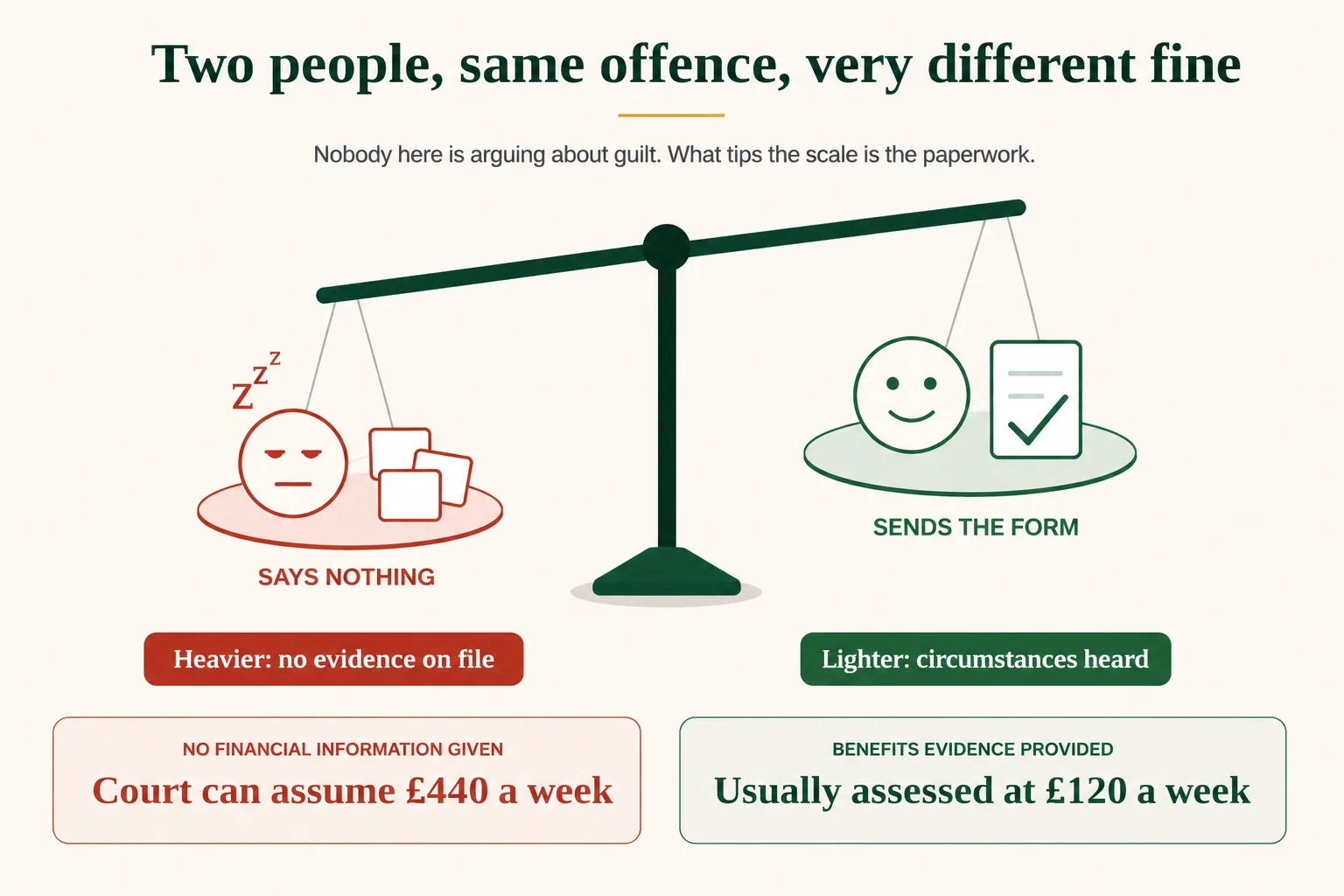
The detail that catches out the most people is what happens if you say nothing at all. Around 80 percent of people who receive a Single Justice Procedure notice never respond to it. When that happens, the magistrate still decides the case, but with only TV Licensing’s version of events in front of them. Unsurprisingly, this results in a guilty finding in the overwhelming majority of cases. Responding, even briefly and even to plead guilty, is almost always better than silence, because it is your only chance to explain your circumstances before a fine is set.
If you are convicted without ever knowing a case existed against you, perhaps because a letter went to an old address, you are not simply stuck with the outcome. You can complete a Statutory Declaration within 21 days of finding out about the conviction, which, if the court accepts it, cancels the conviction and any fine, and effectively restarts the process from the beginning so you can respond properly.
How Much a TV Licence Fine Actually Costs
The £1,000 figure on every letter is a ceiling, not a typical outcome. Courts set fines using sentencing guidelines built around your Relevant Weekly Income, so two people convicted of the same offence can receive very different fines depending on what they earn. If you fill in the court’s financial statement honestly, a low income assessed against benefits is usually treated as around £120 a week, which produces a correspondingly modest fine once the court applies the standard percentage band. If you provide no financial information at all, the court is entitled to assume a weekly income of £440, which produces a noticeably higher fine than most people in that position would actually have been assessed at, had they simply filled in the form.
On top of the fine, courts typically add costs of around £100 to £150 and a victim surcharge set as a percentage of the fine. None of this money goes to the BBC directly. It is collected by the courts, not TV Licensing. For scale, these cases are not a small part of the justice system: they regularly account for more than one in ten of all criminal prosecutions in England and Wales, with several thousand cases heard through the Single Justice Procedure every week.
Can You Go to Prison for Not Having a TV Licence?
No, not for the offence itself. TV licence evasion is punishable by a fine, and a fine alone. Nobody has ever been sent to prison simply for watching television without one, and the law does not allow it. The only route to prison connected to this at all is a completely separate matter: wilfully refusing to pay a fine that a court has already imposed after conviction. Even then, prison is treated as an absolute last resort. A court must be satisfied beyond reasonable doubt that the refusal to pay is deliberate rather than an inability to pay, and that every other method of collecting the money, such as deductions from benefits or a payment plan, has already been tried or properly considered. If you are struggling to pay a fine, telling the court that directly, rather than ignoring it, is what keeps this scenario firmly theoretical.
Stopping It Properly, If You Do Not Need a Licence
If your household genuinely does not watch live television or use BBC iPlayer, there are two legitimate ways to reduce contact with TV Licensing, and it is worth understanding what each one actually does.
The No Licence Needed declaration, completed free on the TV Licensing website, tells them your address does not require a licence. It pauses the standard letter sequence for two years, though it does not guarantee zero contact. TV Licensing may still occasionally check, since by their own figures around 1 in 14 people who make this declaration turn out to need a licence after all.
Some people also choose to write formally to TV Licensing withdrawing what is known as their implied right of access, a common law principle that ordinarily allows callers, including delivery drivers and door-to-door officers, to approach your front door. Withdrawing it in writing is a real and recognised step, and some households use it alongside the No Licence Needed declaration. It is worth being realistic about what it changes: it does not create a stronger legal shield than simply declining entry each time, and in a small number of cases it has been cited as a factor when TV Licensing considered a warrant application, precisely because it signals an unwillingness to engage. For most people who genuinely do not need a licence, the declaration alone, kept up to date, does the job without needing anything further.
If You Do Watch Live TV or iPlayer
None of the above is an argument for ignoring TV letters if your household does actually watch live television or use BBC iPlayer. TV licence enforcement exists because the fee funds public broadcasting, and the licence itself costs £180 a year. Even a fine at the lower end of the sentencing bands, once costs and a surcharge are added, is likely to cost more than several years of the licence fee combined, and it comes with a criminal conviction attached. If you watch live television, the straightforward and cheaper option is simply to buy one.
Frequently Asked Questions
Can TV Licensing officers enter my home?
Not without your permission. Officers have no automatic right of entry. They can only come inside if you invite them in or if they hold a search warrant granted by a magistrate, which is rare and requires genuine evidence, not just a refusal to let them in.
Can I go to prison for not having a TV licence?
Not for the offence itself. TV licence evasion carries a fine, not imprisonment. Prison is only possible as a last resort if someone wilfully refuses to pay a court fine after conviction, and the court must be satisfied beyond reasonable doubt that every other method of collecting the fine has failed.
How much is the fine for not having a TV licence?
The maximum is £1,000, but courts set the real figure as a percentage of your weekly income under sentencing guidelines. If you provide no financial information, the court can assume a weekly income of £440. If you are on benefits and provide evidence, it is usually assessed at £120 a week, which produces a much smaller fine.
What is the Single Justice Procedure?
It is the process that decides almost every TV licence prosecution. A single magistrate reviews the case on paperwork alone, without a courtroom hearing, usually in about two minutes. You can respond in writing within 21 days to plead guilty or not guilty and explain your circumstances.
What happens if I ignore a TV Licensing letter?
Around 80 percent of people who receive a prosecution notice never respond. If nobody replies, the magistrate decides the case using only the evidence TV Licensing has submitted, which usually results in a guilty finding by default.
Do detector vans really work?
Detector vans exist and are used partly as a deterrent, but TV Licensing keeps their real capability against modern streaming devices deliberately vague. Almost all prosecutions rely on a signed doorstep statement rather than detection evidence.