Quick answer: a TV licence for care homes can cost as little as £7.50 a year per room under the Accommodation for Residential Care scheme, known as ARC. It depends on two separate checks: whether the building or scheme qualifies, and whether the individual resident does. The care home manager or warden applies, not the resident, and it covers one room regardless of how many people or televisions are in it.
Many care home residents are still paying the full £180 TV licence fee without realising a concession exists that could reduce it to £7.50 a year. The confusion is understandable: a TV licence for care homes depends on two separate tests, one for the building and one for the resident, and neither TV Licensing’s own guidance nor most care providers explain both clearly in one place. This guide sets out exactly how the ARC scheme works, who is responsible for applying, and how to avoid the mistake that catches out residents moving in.
This Page Is for Two Different People
If you are a resident or a family member, the part that matters most is knowing the concession exists and understanding what happens to an existing TV license when someone moves in. If you are a care home manager, warden, or scheme administrator, the responsibility for actually setting up and maintaining the licence sits with you, not with individual residents. This guide covers both sides, since getting either one wrong tends to cause the other person a problem later.
Two Tests, Not One
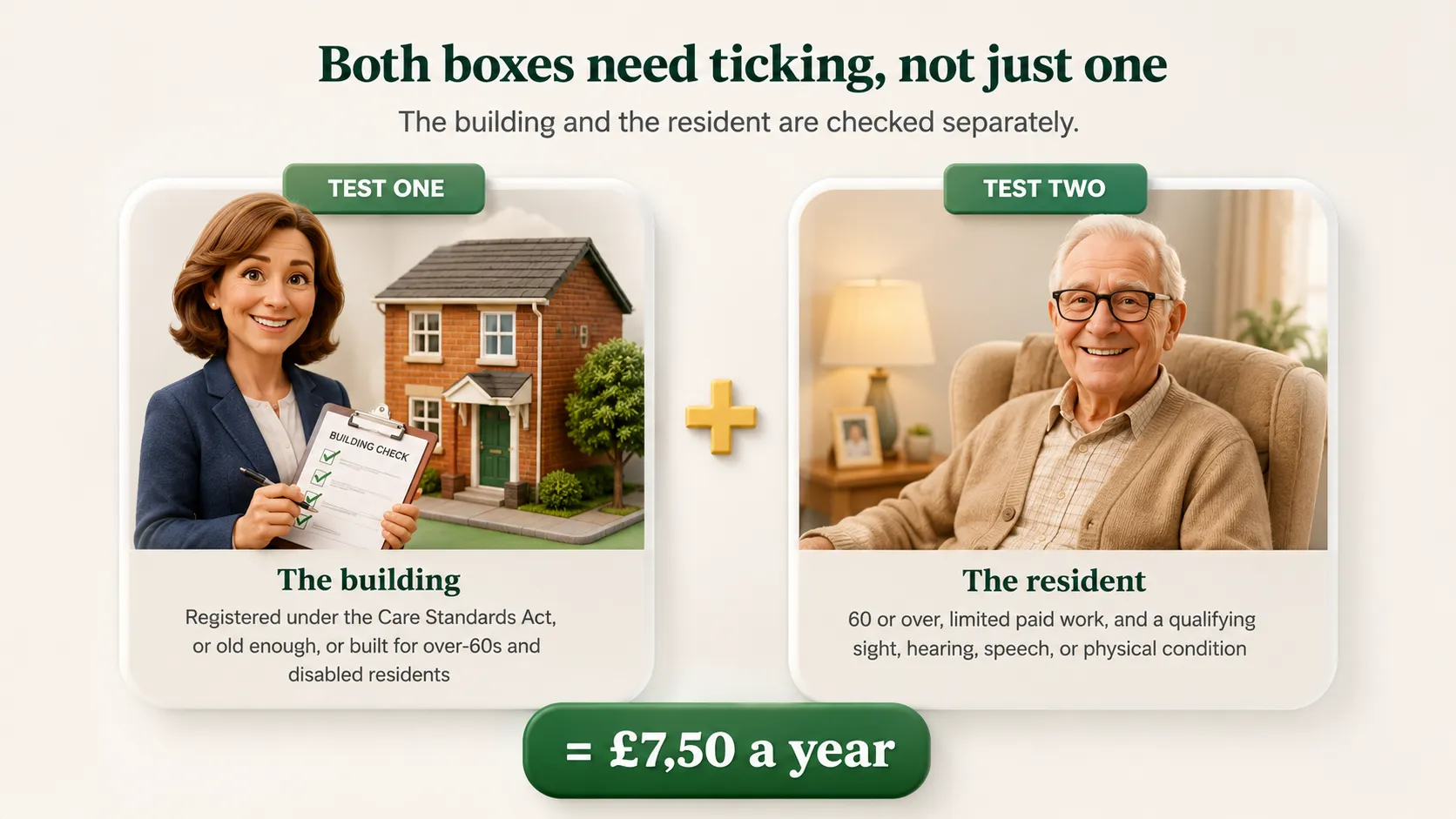
Most confusion around this concession comes from treating it as a single eligibility check, when it is actually two separate ones. Both need to be satisfied before the reduced rate applies.
Test one: does the scheme qualify?
Test two: does the resident qualify?
A scheme that qualifies does not automatically mean every resident in it does, and a resident who personally meets the criteria gains nothing if the scheme itself has never been registered for the concession. Both boxes need ticking.
What It Actually Costs
|
Situation |
Cost |
|
Standard colour licence |
£180.00 a year |
|
ARC concession, per room, flat or bungalow |
£7.50 a year |
The rate applies per room, not per resident or per television, so a shared room with more than one person or more than one set is still covered by a single £7.50 licence.
Who Actually Applies
Residents do not apply for this themselves. The care home manager, warden, or scheme administrator is responsible for checking whether the building qualifies and for adding eligible residents to the scheme. In practice this usually means a family member or resident raises the question, and the administrator handles the paperwork from there, since they hold the scheme-level registration that individual residents cannot access on their own.
If a scheme already has an ARC registration in place, adding a new eligible resident is usually a shorter process than a fresh application, since the building-level test has already been satisfied. The administrator completes a resident addition form confirming the individual meets the resident criteria, and sends it to TV Licensing’s concessionary team.
Moving In With an Existing Licence: Do Not Cancel Too Soon
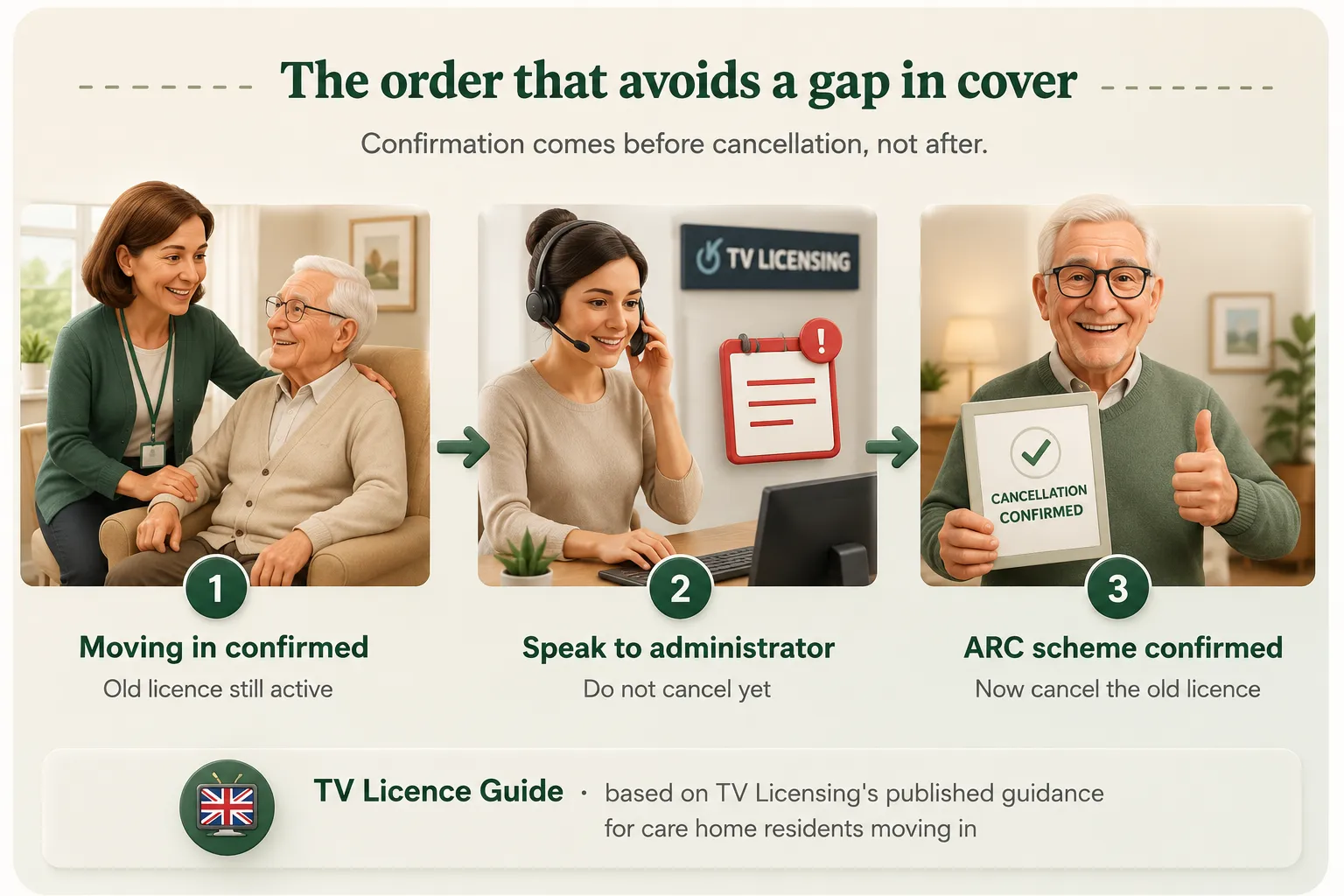
This is the single most common mistake, and it is an easy one to make with good intentions. If you already hold a standard TV licence and are moving into qualifying care accommodation, do not cancel it or stop the Direct Debit until the administrator has confirmed you have actually been added to the ARC scheme. Cancelling early, before that confirmation comes through, can leave a genuine gap where no licence is in place at all.
The correct order is to speak to the administrator as soon as the move is confirmed, let them apply on your behalf, and only cancel the old licence once you know the new one is active. Once that happens, any refund owed on the unused portion of the old licence is usually handled as part of the same process: if you paid by Direct Debit or a TV Licensing payment card, the refund is typically processed automatically, and if you paid in a single lump sum, the administrator completes the refund form for you. The general rules on how refunds are calculated are covered in full in our TV license refund guide.
A Situation Worth Knowing About: Preserved Rights
Some sheltered accommodation schemes lost their ARC eligibility after 1 June 1998, when the rules changed. Existing occupants at the time may still hold what are called preserved rights, meaning they can continue benefiting from the concession even though the scheme itself would no longer qualify for a new registration today. This does not transfer if the resident moves to a different scheme, and it is specific to people who were already living there when the change happened. If this might apply to you or a relative, it is worth raising directly with TV Licensing’s concessionary team rather than assuming the standard eligibility rules settle the matter either way.
Common Mistakes
Cancelling the old licence too early
Wait for confirmation that the resident has actually been added to the ARC scheme before stopping an existing licence or Direct Debit.
Assuming the scheme qualifies without checking
Not every care home or sheltered scheme meets the building-level test, even if individual residents clearly meet the personal criteria.
Residents applying directly
Applications go through the manager or administrator, not the resident, since the scheme-level registration sits with them.
Overlooking preserved rights
A scheme that would not qualify today may still have residents covered under older preserved rights rules, which is easy to miss if nobody checks the scheme’s history.
Frequently Asked Questions
How much is a TV licence in a care home?
A qualifying care home resident can get an Accommodation for Residential Care licence for £7.50 a year per room, flat or bungalow, instead of the standard £180 fee. Not every resident or scheme automatically qualifies.
Who applies for a care home TV licence?
The care home manager, warden, or scheme administrator applies on behalf of residents, not the resident themselves. They are responsible for checking whether the scheme qualifies and adding eligible residents to it.
Do I need to cancel my existing TV licence when I move into a care home?
Not straight away. Speak to the administrator first and wait for confirmation that you have been added to the ARC scheme before cancelling an existing licence or Direct Debit, since cancelling too early can leave you briefly unlicensed.
Does every care home qualify for the ARC licence?
No. The building or scheme itself must meet separate eligibility rules, such as being registered under the Care Standards Act 2000 or meeting specific age and structure criteria, before any resident there can be added to the concession.
Do two people sharing a room need two TV licences?
No. The ARC concession applies per room, flat or bungalow, not per person. A shared room with more than one television still only needs one licence for that room.