What is a TV Licence?
The licence is a legal permission to receive live television and use BBC iPlayer, created under the Communications Act 2003. It attaches to an address, not a person. One licence covers everyone in the household on every device they own, from the living room TV to a phone on the sofa. That single fact answers half the questions people ask: couples do not need two, and a second TV in the bedroom does not need its own.
The government sets the price, and the money funds BBC television, radio, iPlayer and the World Service, plus around £100 million a year for S4C in Wales. TV Licensing, the body that sends the letters, is the collection arm, and its powers are narrower than its letters suggest.
Two things the licence is not. It is not a tax on owning a TV, so a set used only for gaming and streaming needs nothing. And it is not a subscription you can pause, which is why cancelling in the right order matters.
Do You Need a TV Licence?
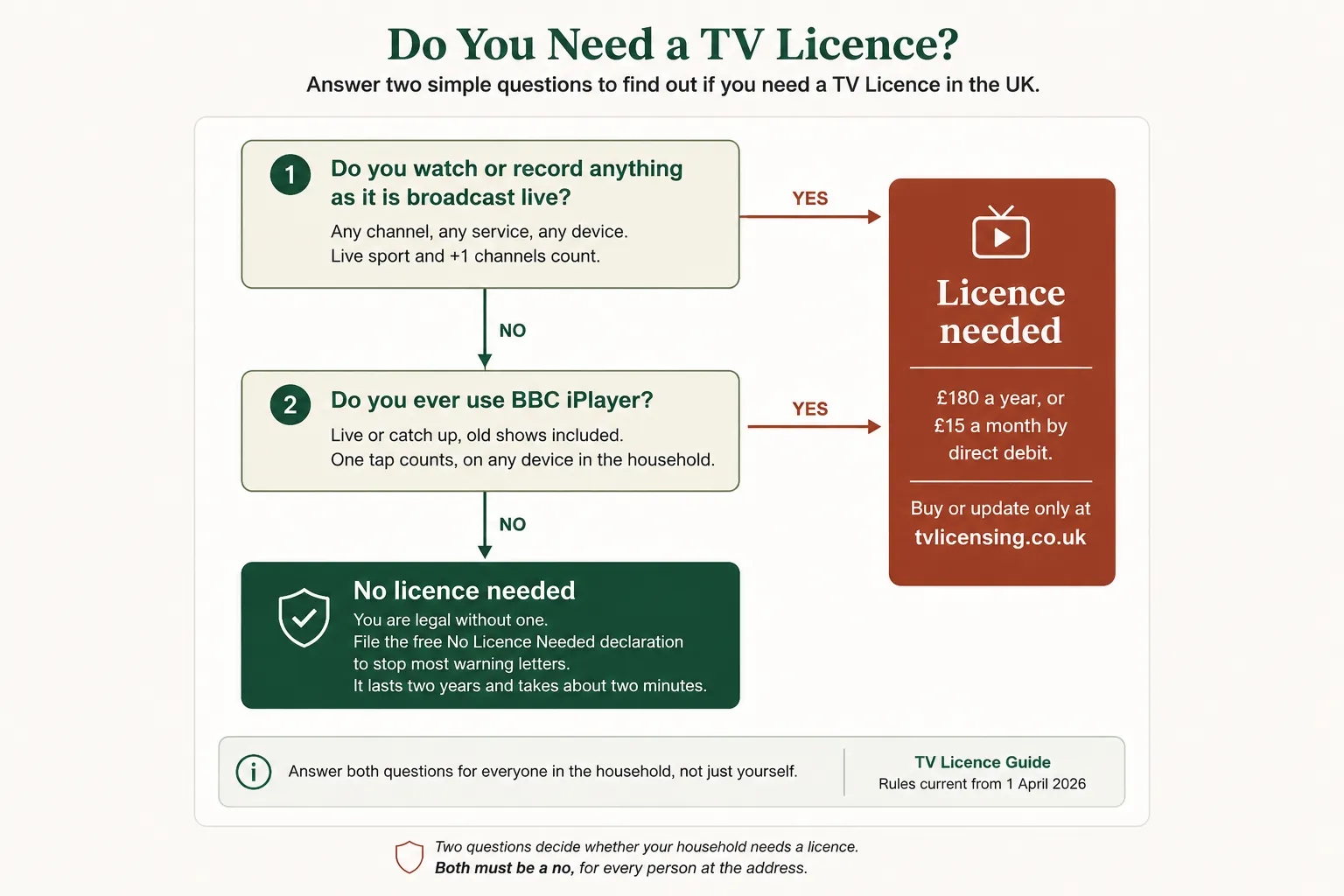
The rule has nothing to do with owning a TV. It comes down to what your household watches. Live means licensed, on demand means free, with one exception that catches thousands of people out: BBC iPlayer always needs a licence, even for old shows on catch up.
Licence needed
You do not need one for
Two more traps worth knowing. Watching +1 channels like ITV1+1 counts as live, because the programme is still being broadcast to everyone at once. And watching away from home on a phone or unplugged laptop is covered by your home licence, but plug the charger in at an unlicensed property and that cover ends. If you plan to go without a licence, delete the iPlayer app from every device in the house first, because one tap on it puts you back in licence territory.
Service by Service
|
Service |
On demand viewing |
Live content |
|
Netflix |
No licence needed |
Licence needed |
|
BBC iPlayer |
Licence needed |
Licence needed |
|
YouTube |
No licence needed |
Licence needed |
|
Prime Video |
No licence needed |
Licence needed |
|
ITVX |
No licence needed |
Licence needed |
|
Sky and Now |
No licence needed |
Licence needed |
On demand means programmes you choose to start yourself. The moment anything streams live inside any app, including sport and premieres, the licence rule applies.
Common Situations
📺
Streaming Only Households
Netflix, Disney+ and on demand ITVX with no live TV and no iPlayer means no licence needed. Millions of households pay £180 they may not owe, simply because nobody told them the rule.
🎓
Students
A halls room or separate tenancy usually needs its own licence. The exception: a device running only on its own battery is covered by the licence at your out of term address. Plug it in and the cover ends. Claim the summer refund when you leave.
📦
Moving House
Your licence covers the address on it, so update it online before moving day at no cost. Moving in with someone who already has one? Claim a refund for your unused months instead.
🏠
Second Homes and Caravans
A holiday home or static caravan needs its own licence if anyone watches there. Touring caravans follow a different rule: they count as an extension of your home when nobody watches at both places at once.
🔑
Landlords and Tenants
A joint tenancy means one licence covers the whole house. Separate agreements per room mean each tenant needs their own. The tenancy paperwork decides who pays, not the landlord.
🏢
Businesses
Any premises where staff or customers watch live TV or iPlayer needs a licence, including screens in waiting rooms and canteens. Hotels get one licence per 15 guest rooms.
How Much a TV Licence Costs in 2026
|
Licence type |
Annual cost |
Monthly equivalent |
|
Colour (standard) |
£180.00 |
£15.00 |
|
Black and white |
£60.50 |
£5.04 |
|
Severely sight impaired (50% off) |
£90.00 |
£7.50 |
|
Care home ARC scheme |
£7.50 |
Not applicable |
The fee rose by £5.50 this April and rises with inflation again in April 2027, when it is expected to pass £185. One quirk worth money: your licence charges the rate in force on the day it starts, so if your renewal falls near April, renewing in late March locks the old price for a full year.
|
Year (from 1 April) |
Colour licence |
Change |
|
2024 |
£169.50 |
Up £10.50 |
|
2025 |
£174.50 |
Up £5.00 |
|
2026 |
£180.00 |
Up £5.50 |
|
2027 |
Rises with inflation |
Confirmed |
The current BBC Charter ends in December 2027 and the funding model is under government review, so the fee’s long term future is an open question.
Ways to Pay, Compared
Monthly Direct Debit
£15 a month with nothing added, but know the first year quirk: new payers pay about £30 a month for six months while half the licence is paid off early, then it settles at £15.
Annual Payment
Exactly £180 in one go by card, direct debit or cheque. If your renewal falls near the April rise, paying just before the new rate starts saves £5 or more.
Quarterly Direct Debit
The trap option. Every payment carries a £1.25 premium, £5 a year, for nothing in return. There is no good reason to choose it when monthly costs nothing extra.
Simple Payment Plan
Smaller fortnightly or monthly amounts at no premium, for households that struggle with the standard schedule. TV Licensing or a debt advice charity has to refer you onto it. There is no general low income discount, so this is the route that exists.
Payment Card at PayPoint
You can no longer pay at the Post Office. Cash payers now use a free TV Licensing payment card at any PayPoint shop instead, weekly, fortnightly or monthly.
Which One Fits You?
Every method with setup steps, dates and the small print is compared side by side in the payment guide and the Simple Payment Plan guide.
Free and Discounted Licences
Three groups pay less than the standard fee, and the biggest concession is widely misunderstood in two ways at once.
Over 75s on Pension Credit. Households where someone aged 75 or over receives Pension Credit get a free licence covering everyone at the address. Catch one: the old scheme covering every over 75 ended in August 2020, yet many families still believe it exists. Catch two: the free licence is not applied automatically. You have to claim it, online or by phone, once you qualify. Around 800,000 eligible pensioners never claim Pension Credit at all, and they lose the free licence with it. If you have been paying full price while eligible, you can claim the difference back.
Blind and severely sight impaired. Half price at £90. The licence must be in the registered person’s name, the application needs a copy of the certificate from a local authority ophthalmologist, and one certificate then covers the whole household. Partially sighted viewers do not qualify. Details in the blind concession guide.
Care home residents. Accommodation covered by the ARC scheme pays £7.50 a year per room, provided the resident is over 60 and retired, or disabled, with the scheme manager applying on their behalf. See the care home guide.
How to Cancel Your TV Licence
You can cancel at any time without giving a reason, as long as your viewing genuinely no longer needs a licence. Cancelling while you still watch live TV or use iPlayer is an offence, so be honest about the household’s habits first. Done in the right order, it takes five steps.
Confirm your viewing qualifies
No live TV on any channel, service or device, and no iPlayer at all. Delete the iPlayer app from every device so nobody in the house taps it by habit.
Cancel the licence before the direct debit
The order matters. Cancel through your TV Licensing account or by phone first. Cancelling the bank payment while the licence stays active flags your account as unpaid and triggers late payment letters.
Claim your refund
Every full unused month comes back to you at about £15, normally paid within 21 days. You need at least one full month left, you can apply up to 14 days before the date you stop needing the licence, and claims stay open for two years after expiry.
File the No Licence Needed declaration
Optional but worth it. The declaration stops most warning letters and lasts two years before renewal. It takes about two minutes on the TV Licensing website. What it commits you to is covered in the declaration guide.
Expect one possible visit
TV Licensing says around 1 in 14 people who declare turn out to need a licence after all, which is why they sometimes check. If your declaration is truthful, the visit is nothing to worry about.
Before you cancel, be honest about the trade. Around two million UK households now legally pay nothing, keeping Netflix, Disney+ and every catch up service except iPlayer. What they give up is live everything: news channels during big events, live sport, and the entire BBC catalogue. For some households that trade is painless. For others, live news alone makes the £15 a month worth paying, and that is a perfectly good outcome too. The point is to choose deliberately instead of paying by default. The full picture is in living licence free.
Refunds are not only for cancellations. People claim after moving in with someone who already has a licence, paying twice by mistake, or discovering a concession they qualified for all along. Cancelling correctly stops the letters that follow, and it’s also what unlocks a refund in every situation that qualifies.
Common Mistakes That Cost Real Money
Most of what people lose in this system comes from a handful of avoidable errors. Check this list before you pay, cancel or reply to a letter.
Cancelling the direct debit before the licence
The account shows active but unpaid, and the late payment letters start. Always cancel the licence itself first, then the bank payment.
Paying quarterly by direct debit
The £1.25 per payment premium adds £5 a year for nothing. Switch to monthly or annual and keep the £5.
Keeping iPlayer installed after cancelling
One tap on the app makes you licensable again. Catch up on ITVX and Channel 4 stays free, iPlayer never is.
Assuming the over 75 licence is automatic
It ended for most over 75s in 2020, and even those who qualify through Pension Credit must apply. Nobody applies for you.
Renewing in early April
The licence charges the rate on its start date. A late March renewal locks the old price for a full year and saves the rise.
Signing the doorstep form under pressure
Nearly all prosecutions rest on a signed doorstep statement. You are not obliged to answer questions or sign anything, and you can end the visit at any time.
Skipping the No Licence Needed declaration
Without it, the warning letters continue on a rolling cycle. Two minutes online stops most of them for two years.
Missing the student summer refund
Students who go home for summer can claim back the unused months. TV Licensing does not advertise it, so most never claim.
Enforcement: What Really Happens If You Do Not Pay
Watching live TV or using iPlayer without a licence is a criminal offence. The maximum fine is £1,000, but the letters never mention what courts actually hand out: first offences typically bring a fine of a few hundred pounds scaled to your income, plus costs of around £200, well below the maximum but still far more than the licence costs, so if you watch live TV, buy the licence. Around 12.5% of UK addresses currently evade the fee, and enforcement is real, just not the way the letters make it sound.
The letters are automated and arrive on a rolling cycle whether or not anyone has looked at your case. If they get no response, a visiting officer may call, and this is the part most people never learn: officers have no right of entry. They can only come inside if you invite them or hold a search warrant signed by a magistrate, which is rare and usually executed with police present. You can decline the visit and close the door. You can even write to TV Licensing and withdraw their implied right of access, which bars officers from approaching your door at all, a documented option that thousands of households have used.
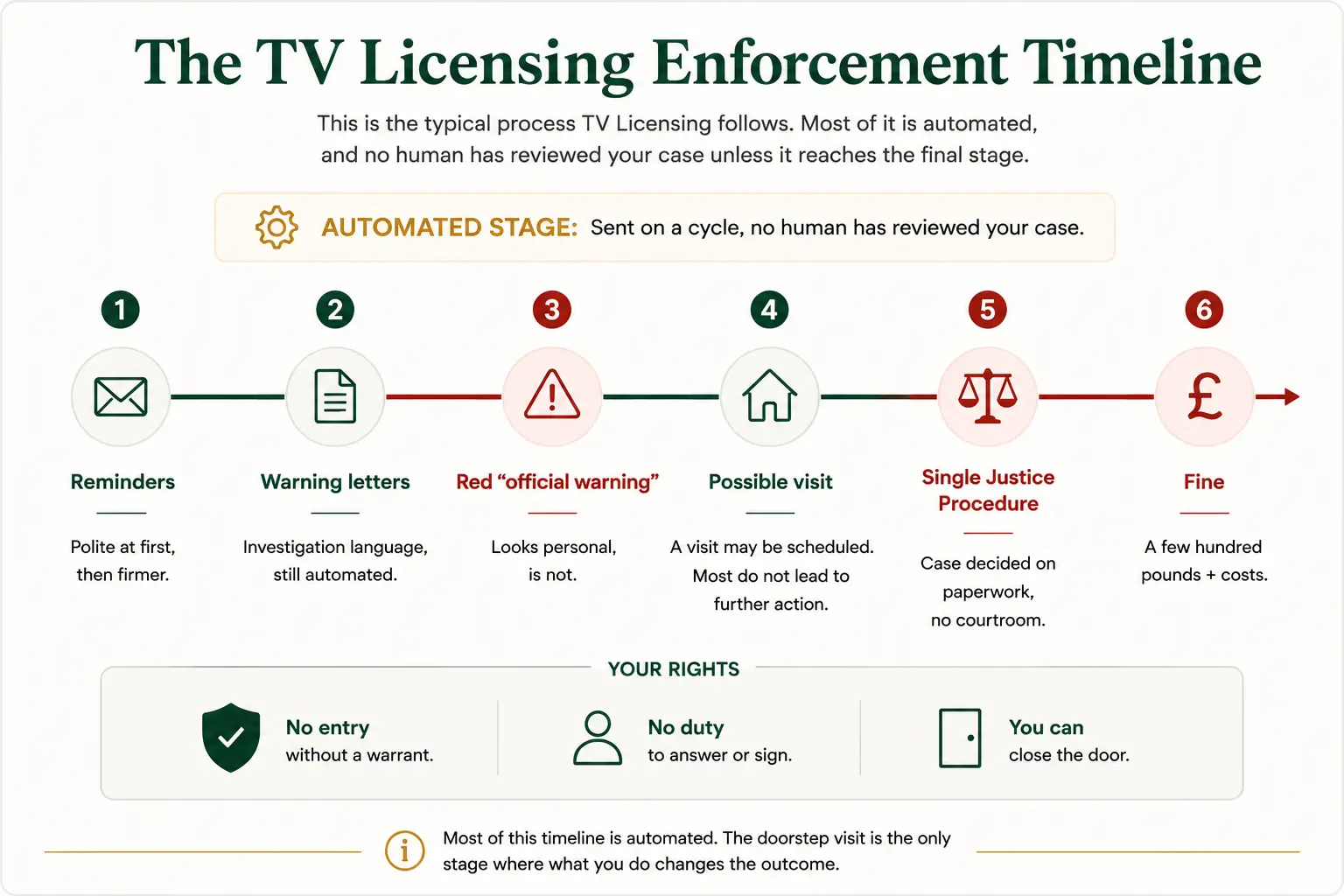
Detector vans feature heavily in TV Licensing publicity, but detection evidence has almost never formed the basis of a prosecution. Nearly all convictions come from doorstep confessions, where the resident admits watching live TV and signs the officer’s form. Cases that do proceed mostly never see a courtroom: the vast majority go through the Single Justice Procedure, decided on paperwork by a single magistrate, and the realistic amounts are covered in the fine guide.
One fear worth retiring: you cannot be sent to prison for evasion itself. The offence carries a fine, not imprisonment. Jail only enters the picture if someone refuses to pay a court fine after conviction, which is a separate matter entirely. If you genuinely do not need a licence, you should not be scared into paying by letter number seven. Read the enforcement guide, decode your specific letter with the letter decoder, and know your rights with the right of entry guide.
Not Sure Where You Stand?
Work through how your household actually watches and get a clear yes or no on whether you need a licence, plus what to do next either way.
Frequently Asked Questions
Is a TV licence per person or per household?
One licence covers everyone living at the same address, on every device they own. Couples, families and joint tenancy house shares all need just one.
Do I need a TV licence to watch Netflix?
No, not for normal on demand viewing. The only exceptions are live channels or live events streamed inside the app, which count as live TV. The same rule applies to Prime Video and Disney+.
How much is a TV licence in 2026?
£180 a year for a standard colour licence from 1 April 2026. A black and white licence is £60.50, and severely sight impaired viewers pay £90.
Do I need a licence for a smart TV I only use for streaming?
No. Owning any TV is fine without a licence. You only need one if you watch live broadcasts or use BBC iPlayer on it.
Can TV Licensing officers enter my home?
Not without your permission. They have no automatic right of entry and can only enter with your consent or a court issued search warrant, which is rarely granted and usually executed with police present.
Do over 75s get a free TV licence?
Only households where someone aged 75 or over receives Pension Credit, and you must apply for it. It is not given automatically. The universal free licence for all over 75s ended in August 2020.
What happens if I watch TV without a licence?
It is a criminal offence. The maximum fine is £1,000 plus costs, though first offences typically bring a few hundred pounds, scaled to income. Most cases start with a doorstep visit and are decided on paperwork through the Single Justice Procedure, not a courtroom.
Can I go to prison for not having a TV licence?
Not for evasion itself. Watching without a licence carries a fine, not imprisonment. Jail is only possible for refusing to pay a court fine after conviction, which is a separate matter.
How do I get a TV licence refund?
Apply on the TV Licensing website with your licence number. You get back about £15 for each full unused month, and payment usually arrives within 21 days. Claims stay open for two years after a licence expires.
Do students need their own TV licence?
Usually yes, for their own room in halls or a house with separate tenancy agreements. The exception is watching on a device running only on its own battery, which is covered by the licence at your out of term address. Students can also claim a refund for the summer months.
How do I stop TV Licensing letters?
If you genuinely do not need a licence, file the No Licence Needed declaration on the TV Licensing website. It stops most letters for two years. You can also write to withdraw their implied right of access, which stops doorstep visits too.