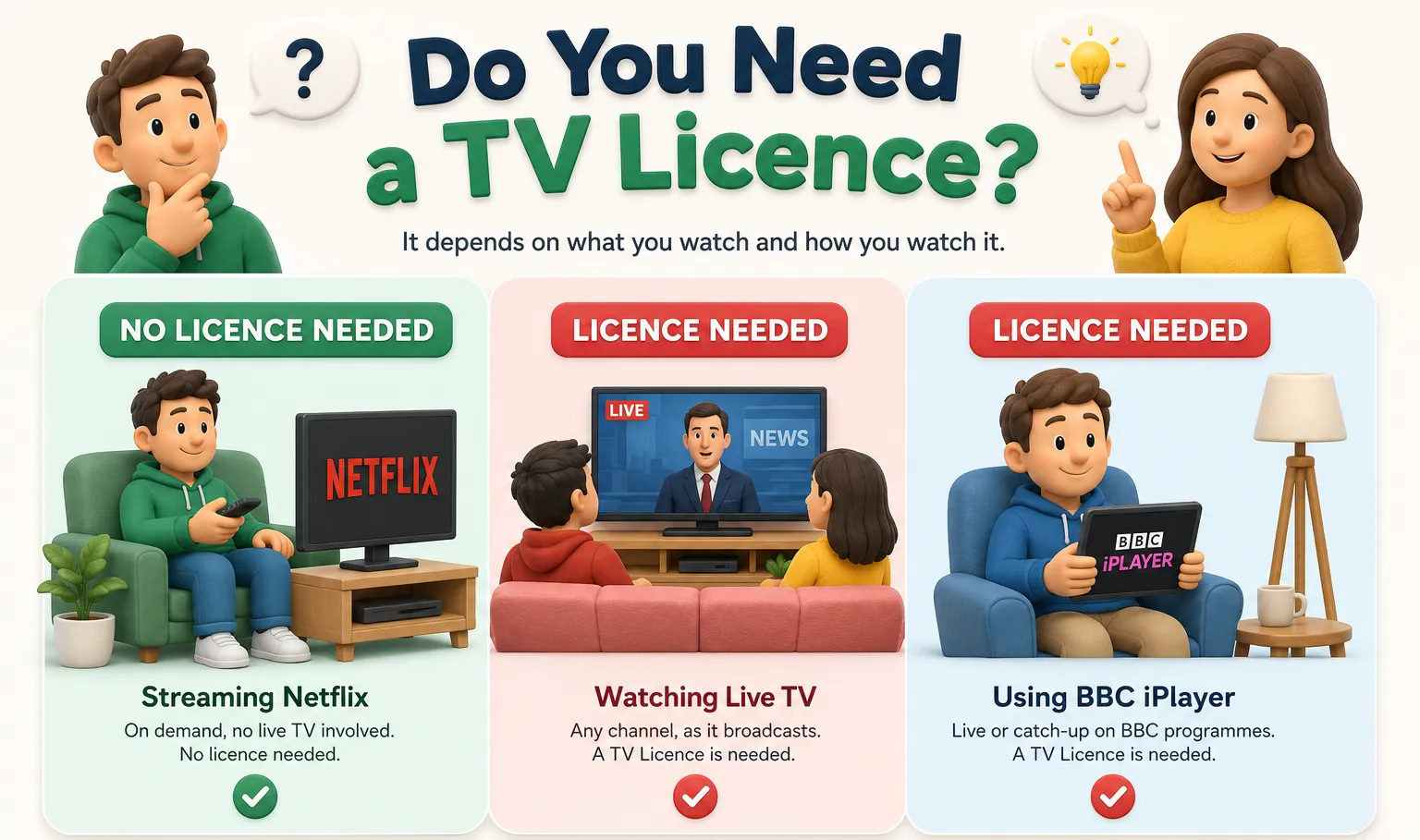
Quick answer: you need a licence if anyone at your address watches live television on any channel, or uses BBC iPlayer in any way. You do not need one if you only watch on demand services such as Netflix, Prime Video, or catch-up TV on apps other than iPlayer. One licence covers the whole address and every device in it.
The rule behind a TV licence is simpler than the letters and adverts make it sound, and most of the confusion comes from a single exception that catches people out. This page sets out exactly what counts, what does not, and how each major streaming service fits into the rule, so you can check your own situation in a couple of minutes rather than guessing.
The Rule in One Sentence
You need a licence if you watch live television on any channel, on any device, or if you use BBC iPlayer at all. Everything else, every on demand service, every catch-up app apart from iPlayer, needs no licence whatsoever. That is the entire rule. Almost every question people have about specific services comes down to which side of that line the service falls on.
What Actually Requires a Licence
You need a licence for
You do not need one for
The recording rule surprises almost everyone. Record a live programme to watch that evening, and you needed a licence at the exact moment you recorded it, even though you have not actually watched anything live yourself. The licence is about receiving the broadcast, not about when you eventually sit down and watch it.
This is also why the rules can feel inconsistent at first glance. Two people could watch the exact same episode on the exact same channel, one live and one a few hours later on catch-up, and only one of them needs a license at that moment. What decides it is simply whether the signal is arriving live, right now, or whether it was already recorded and stored for you to watch afterward.
This is also why a smart speaker or a radio does not trigger the rule on its own. Radio has never required a television licence, regardless of whether you listen live or on catch-up, since the licence has only ever covered television broadcasting and BBC iPlayer specifically.
Every Major Service, Checked
|
Service |
Do you need a licence? |
|
Netflix |
No, on demand only |
|
Prime Video |
No, on demand only |
|
Disney+ |
No, on demand only |
|
Apple TV+ |
No, on demand only |
|
BBC iPlayer |
Yes, always, live or catch-up |
|
ITVX |
Only for live channels, not catch-up |
|
All 4 |
Only for live channels, not catch-up |
|
My5 |
Only for live channels, not catch-up |
|
YouTube |
Only for live streams, not ordinary videos |
|
Sky, Virgin, Freeview, Freesat |
Yes, for any live channel |
Do I Need a TV Licence for Netflix, Prime Video or Disney+?
No. All three are entirely on demand services with no live broadcast element at all, so nothing about them ever requires a licence, regardless of how much you watch or how many profiles are set up on the account. This answer does not change based on subscription tier, household sharing, or downloading content to watch offline. If your only viewing across the whole household is through services like these, you do not need a TV licence.
Do I Need a TV Licence for BBC iPlayer?
Yes, always. This is the single exception to the on demand rule, and the reason comes down to how iPlayer is funded rather than how it works technically. Every other catch-up service, ITVX, All 4, My5, is paid for through advertising or subscription, so there is no licence fee argument for covering their on demand content. iPlayer exists because of the licence fee, so the rule treats any use of it, live or catch-up, as something the fee is meant to pay for. This applies even if you only ever use iPlayer to watch old episodes days or weeks after they aired, with no live viewing anywhere in your household.
Do I Need a TV Licence for YouTube?
It depends entirely on what you are watching. YouTube is not a broadcaster in the traditional sense, but a live stream is treated as a live broadcast the moment it is airing. A pre-recorded video uploaded days ago needs no licence, however popular it is or however much it resembles television. Watch a live sports event or a scheduled premiere as it happens, though, and the same rule applies as any other live broadcast.
Do I Need for ITVX, All 4 or My5?
Only for the live parts. These apps genuinely offer both sides of the line in one place, which is exactly why they confuse people. Open ITVX and you can watch a live simulcast of ITV1 as it broadcasts, which needs a license, or something that finished airing last week, which does not, all from the same app. All 4 and My5 work the same way. If you are ever unsure, just check whether what is on your screen is happening live right now or already happened.
Do I Need If I Have Sky?
Having a Sky box or subscription does not by itself require a licence. What requires one is watching live television through it, on any channel. Sky’s on demand library works the same as any other on demand service and needs no licence on its own. If you use Sky only for on demand content and never watch a channel live, you do not need a TV license for it, though most Sky households do watch at least some live television and need one for that reason.
One Licence Covers the Whole Address
A TV licence is tied to an address, not to a person or a single device. Once your household has one, it covers every television, laptop, tablet, and phone at that address, used by anyone living there. You do not need a second licence for a second TV, and you do not need to add household members to it individually.
This also means the licence travels with you on a portable device. If you take a laptop or tablet away from home and it is running on its own battery, without being plugged into the mains at someone else’s address, it is still covered by your home licence. Plug it into the mains at another address, and you are relying on whether that address has its own licence instead.
Situations That Confuse People
Watching on a phone away from home
Covered by your home licence as long as the device is running on battery power, not plugged in elsewhere.
A smart TV with mixed apps
The apps themselves do not decide it. What matters is whether what you are watching in that moment is live or on demand.
Students living away from home
A separate address generally needs its own licence, unless every device there only ever runs on battery power and is genuinely still covered by a home licence elsewhere.
Free trials of streaming services
A Netflix or Disney+ trial does not require a licence. Even signing up for BBC iPlayer and browsing without watching anything is fine on its own, it is only once you actually use it that a licence becomes necessary.
Second Homes, Shared Houses, and Caravans
A separate property generally needs its own licence if anyone there watches live television or uses iPlayer, since the licence is tied to the address rather than to a person who already holds one elsewhere. This applies to second homes, holiday cottages, and static caravans used for any length of time. The one exception remains portable devices running purely on battery power, which stay covered by whichever licence they are normally associated with, wherever they happen to be.
Shared houses work slightly differently depending on the tenancy arrangement. If a property is let as a single household under one tenancy, one licence covers the whole address, the same as any family home. If rooms are let individually, with genuinely separate tenancy agreements and separate facilities, each let unit may need its own licence. This situation is common enough that it deserves its own dedicated explanation, which we cover separately for landlords and tenants.
Still Not Sure?
If your household mixes several services and habits, the general rule can feel harder to apply than it actually is. Working through it properly usually takes less than a minute if you ask the questions in the right order.
Does anyone in your household use BBC iPlayer, ever?
If yes, you need a licence. This answer alone settles it, regardless of anything else in the house.
Does anyone watch a live broadcast on any channel?
This includes terrestrial channels, satellite, cable, and live simulcasts through apps like ITVX. If yes, you need a licence.
Is every device in the house used only for on demand content?
Streaming services, catch-up apps other than iPlayer, downloaded content, and pre-recorded YouTube videos. If this covers everything and the first two answers were both no, you do not need a licence.
Check again if anyone’s habits change
A licence is not a one-time decision. If someone moves in, starts using iPlayer, or a smart TV app starts offering live channels it did not before, it is worth running through these questions again.
Why This Rule Exists at All
The distinction between live broadcasting and on demand viewing is not arbitrary. The licence fee funds live broadcasting and BBC services specifically, under the Communications Act 2003, rather than television as a general concept. On demand services outside the BBC are funded through their own subscriptions or advertising, so there is no basis for the licence fee to cover them, and the law has never attempted to extend it that way. This is also why the rule has stayed broadly consistent even as viewing habits have shifted dramatically toward streaming over the past decade. The technology changed. The underlying question, live broadcast versus stored content, did not.
Businesses and Shared Premises
The same rule applies away from home. Any business premises where staff or customers might watch live television or use BBC iPlayer needs a licence, at the same rate as a household licence. This covers staff rooms, waiting areas, and shop floors with a television playing, whether or not customers are actually watching it at any given moment. Hotels and similar overnight accommodation work slightly differently, since a single licence can cover a number of guest rooms rather than needing one per room, which is covered in full in our guide to TV licence costs. Offices where nobody ever watches live television or uses iPlayer, purely using screens for presentations or on demand content, do not need one.
What to Do With Your Answer
What Happens If You Get This Wrong
Getting the answer wrong in either direction has a different consequence, and it is worth being honest about both. Buying a licence you do not actually need costs you £180 a year for nothing, though it is easily fixed since you can cancel and often claim a refund once you realise. Deciding you do not need one when you actually do is the more serious mistake, since watching live television or using iPlayer without a licence is a criminal offence, regardless of whether the decision was a genuine misunderstanding. If you are ever unsure, the safer starting point is to check properly using the steps on this page rather than assume, and our guide to TV licence enforcement explains exactly what happens if an address is found to need one and does not have it.
Frequently Asked Questions
Do I need a TV licence to watch Netflix?
No. Netflix is an on demand service. As long as you never watch live television on any channel and never use BBC iPlayer, you do not need a licence, whether or not you have Netflix.
Do I need a TV licence for BBC iPlayer?
Yes, always. Any use of BBC iPlayer requires a licence, including watching an old episode on catch-up. This is the one exception to the on demand rule, since every other catch-up and streaming service does not require one.
Do I need a TV license to watch YouTube?
It depends what you are watching. Ordinary YouTube videos and replays do not require a licence. Watching a live stream on YouTube at the time it is broadcast does require one, in the same way any other live broadcast does.
Do I need a TV licence if I only watch catch-up TV?
It depends on the service. Catch-up through most broadcasters’ apps, such as ITVX or All 4, does not require a licence if you are watching a programme that has already aired rather than live. BBC iPlayer is the exception and always requires a licence, even for catch-up.
Do I need a TV licence for a second TV or laptop?
No. A TV licence covers every device at your address, not one device or one person. You do not need a separate licence for a second television, a laptop, or a phone in the same household.
Do I need a TV licence if I never watch anything live?
No, as long as that is genuinely true across every device in your household and nobody uses BBC iPlayer either. If everything you watch is on demand content from services other than iPlayer, you do not need a licence.