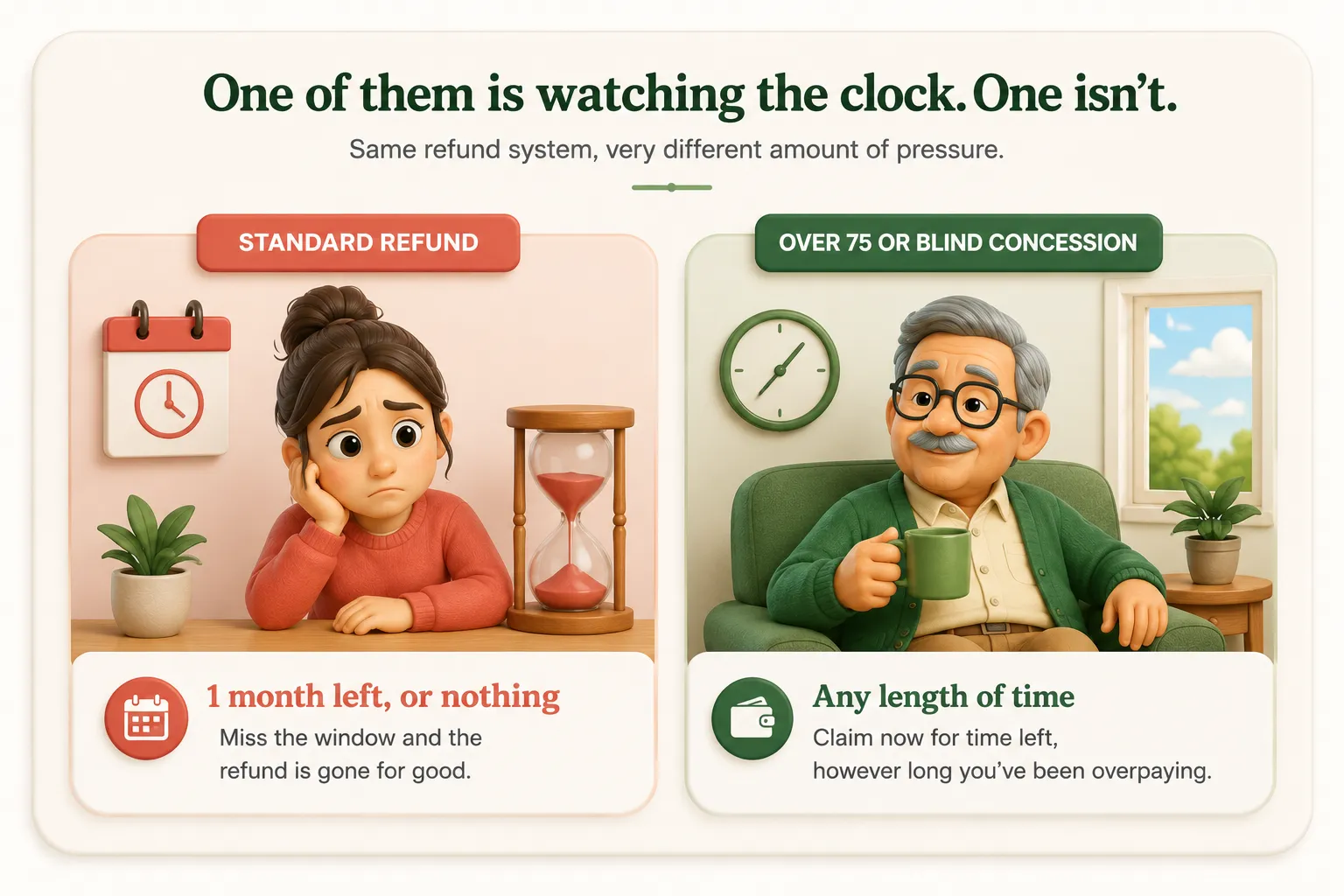
Quick answer: you can usually claim a TV licence refund if you have at least one full month left unused and will not need the licence again during that time. You get back roughly £15 for each complete month remaining, claimed online, and TV Licensing aims to pay it within 21 days. Over 75s and blind concession holders follow a more generous rule and can claim for any length of time left, however long ago they became eligible.
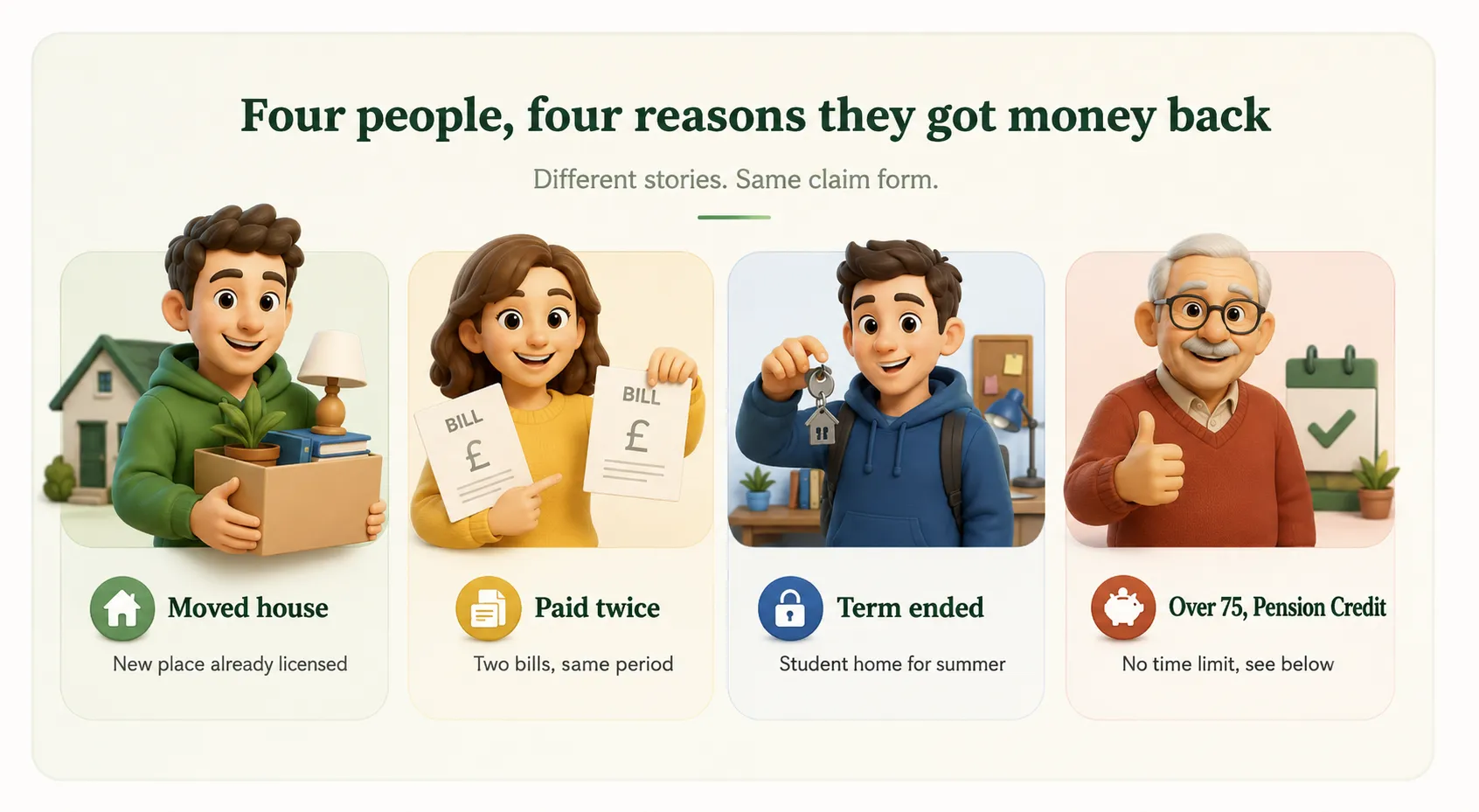
Getting money back is not just something that happens when you cancel. People are owed money for reasons that have nothing to do with deciding they no longer want a licence: moving in with someone who already has one, being charged twice by accident, or discovering years later that they qualified for a free or discounted licence the whole time. Across UK households, unclaimed refunds add up to a meaningful sum every year, mostly because people simply do not know to ask. This guide covers who actually qualifies, how the amount is worked out, and the situations that catch people out.
Who Is Eligible for a Refund
TV licence refund eligibility comes down to one number: how many full months you have left. You can claim a refund if there is at least one complete month between the date you cancel and the date your licence was due to expire, and you are confident you will not need a licence again during that time. If less than a month remains, no refund applies, though you can still cancel the licence itself.
You are likely eligible if
You are not eligible if
How Much You Actually Get Back
The TV licence refund amount is based on complete unused months, not part months, and not a flat percentage of what you paid. At the current annual rate of £180, each full month remaining works out at roughly £15. If you had, for example, four complete months left when you cancelled, you would be looking at around £60 back. Partial months are not counted, so timing your cancellation just after a monthly renewal point rather than a few days before it can make a genuine difference to what you receive.
If you did not pay for the full year upfront, your licence’s expiry date may already reflect what you have actually paid for, which changes the calculation slightly. You can check your exact expiry date by signing in with your licence number, name, and postcode before working out what you are likely owed.
The Refund Nobody Tells Pensioners About
This is the single most valuable thing on this page for anyone over 75, and it is the part of TV licence refund pensioners rarely hear about. A 75 year old TV licence refund follows different rules entirely: the standard one month minimum does not apply to you. If you are 75 or over and eligible for a free licence through Pension Credit, or if you qualify for the blind concession, you can claim a refund for any length of time remaining on a licence you already paid for, no matter how long ago you became eligible.
In practice, this means someone who turned 75, qualified for Pension Credit, and kept paying full price for years without realising can still claim back the unused portion of their current licence. It does not stretch back to refund every year you overpaid in the past, since a licence is only refundable against the time left on the one you are currently holding, but it removes the usual one month cut off entirely for this group. If this applies to you or someone you know, it is worth checking sooner rather than later, since the money is sitting there unclaimed until someone asks for it. Full detail on who qualifies for a free or discounted licence is covered in our TV licence cost article.
If You Paid Your TV Licence Twice by Mistake
Being charged for a TV licence paid twice happens more often than people expect, usually around a house move, a change of bank account, or switching from Direct Debit to paying in full while an old payment was still processing. If TV Licensing has taken two payments covering the same period, contact them directly, explain the overlap, and the duplicate payment is refunded once confirmed. Keep any payment references or bank statements showing both charges, since they make the claim quicker to resolve.
Students Going Home for the Summer
If you bought a licence to cover a year in student accommodation and you are heading home before it runs out, you can usually claim back the full calendar months you will not be there. Only complete months count, so leaving partway through a month means that month itself is not included, only the full months after it. Moving out of student accommodation and back to an address that already has its own licence is normally all that is needed to qualify.
Bereavement: Claiming on Behalf of Someone Who Has Died
If a licence holder has died, their estate is generally entitled to a refund covering the exact unused period, calculated precisely rather than rounded to full months in this specific situation. This is usually handled as part of the wider process of managing the person’s affairs, and TV Licensing has a dedicated route for reporting a death and dealing with the licence, separate from the standard refund form.
Moving House: Refund or Transfer?
If you are moving rather than stopping television altogether, a refund is often not actually the right tool. TV Licensing’s own guidance is clear that if you are moving home, you should move your licence to the new address rather than claim a refund and buy a fresh one, since transferring keeps continuous cover and avoids any gap. A refund makes more sense specifically when the new address already has its own licence in place, or when nobody at the new address will need one at all. Our cancellation guide covers the moving house process in more detail.
Care Homes and Sheltered Housinga
If you are moving into a care home or sheltered accommodation, check first whether the building already holds its own licence covering residents. If it does, you can cancel your personal licence and claim a refund for the unused time, rather than paying for cover you no longer need alongside cover the building already provides.
Refund or Just Let It Lapse?
Some people assume that if a licence is about to run out anyway, it is not worth the hassle of claiming anything back. That is usually the wrong call. Submitting a claim takes a few minutes online, the refund and cancellation happen together, and there is no downside to checking, even if the amount turns out to be modest. Letting a licence simply expire without checking means walking away from money that is genuinely yours, for no real saving in time or effort.
The only time it makes sense to skip claiming is when you already know less than a full month remains, since no refund applies in that situation anyway. Everything else is worth a two minute check.
How to Claim Your Refund
Claiming is handled through the same form as cancellation, so you are not filling in two separate requests, and you can do the whole thing online in a few minutes once you have your licence details to hand.
Check your licence expiry date
Sign in with your licence number, the name on the licence, and your postcode to see exactly when it is due to run out.
Confirm you have at least one full month left
Unless you are claiming under the over 75 or blind concession rule, which does not carry this restriction.
Complete the refund and cancellation form online
The claim and the cancellation are handled together, so you do not need to submit them separately.
Wait up to 21 days for payment
Paid by cheque or directly into your bank account once your claim has been reviewed and approved.
What Happens Once You Have Claimed
This is administered through TV Licensing rather than the BBC directly, though the fee itself funds BBC services. Once a refund is approved, your licence is cancelled automatically as part of that decision, so there is no separate cancellation step to complete afterward. It is worth knowing that TV Licensing does not reconsider claims or adjust the amount once a refund has already been processed, so it is worth checking your expected figure and your expiry date carefully before you submit, rather than assuming you can query it afterward if the amount looks smaller than expected.
How Long You Have to Claim
You do not have to claim the moment you become eligible. In practice, you can typically claim for unused months going back around eleven months, and you generally have up to two years after a licence has expired to make that claim. This matters most for people who did not realise they were owed money at the time, such as someone who moved house a year ago and never got around to sorting out the old licence.
A Quick Way to Check Before You Claim
|
Your situation |
Likely outcome |
|
Cancelling with 3+ months left, no other reason |
Refund for those full months |
|
75 or over, on Pension Credit, still paying full price |
Refund for remaining time, whenever you claim |
|
Charged twice for the same period |
Duplicate payment refunded once confirmed |
|
Moving to an address already licensed |
Refund on the old licence, no transfer needed |
|
Less than a month left before expiry |
No refund, but you can still cancel |
Common Mistakes That Cost People Money
Assuming a refund happens automatically
Nobody checks your account for you. If you do not submit a claim, the money simply is not paid out.
Cancelling a few days too early
Since only full months count, cancelling just before a monthly point rather than just after it can lose you a whole month’s refund.
Not checking the over 75 rule
Pensioners who assume the one month minimum applies to them often miss out on a bigger refund they were actually entitled to.
Requesting a refund instead of a transfer when moving
This can leave a short gap in cover at the new address if it is not already licensed.
Frequently Asked Questions
Am I eligible for a TV licence refund?
Generally yes, if you have at least one full month left before your licence expires and you will not need it again during that time. There is no refund if less than a month remains. Over 75s and blind concession holders follow a more generous rule and can claim for any length of time remaining, however long ago they became eligible.
How much is a TV licence refund?
You get back the value of each full month left unused on your licence, based on what you actually paid. At the current £180 annual rate, that works out at roughly £15 for each complete month remaining. Part months are not refunded.
How long does a TV licence refund take?
TV Licensing aims to process and pay refunds within 21 days of receiving your claim, by cheque or directly into your bank account. If approved, your licence is cancelled automatically at the same time.
Can I claim a TV licence refund after it has expired?
Yes, within limits. You can typically claim for months you did not use going back up to around eleven months, and you generally have up to two years after the licence expired to make that claim.
Can I get a refund if I paid for a TV licence twice?
Yes. If you were charged twice for the same period, for example during a house move or a change of payment method, TV Licensing will refund the duplicate payment once you contact them and explain the overlap.
Can pensioners get a full TV licence refund?
If you are 75 or over and eligible for a free licence through Pension Credit, you can claim a refund for any length of time remaining on a licence you already paid for, no matter how long ago you became eligible. This is more generous than the standard one month minimum rule.