TV licence letters are designed to worry you, and they are very good at it. Bold red type, official sounding phrases, deadlines, warnings about investigations and visits. What almost nobody tells you is that these letters carry no legal weight at all. They are not court documents, they are not fines, and ignoring one is not an offence.
That does not make them meaningless, and this page is not going to tell you to throw every letter in the bin without reading it. There is a real difference between a marketing letter and a court summons, and knowing which is which is the whole point. This guide walks through the letters in the order they usually arrive, explains what each one actually does, and covers the only two things that genuinely stop them.
Why You’re Receiving TV Licence Letters
TV Licensing keeps a database of every address in the country and matches it against the licences it has issued. Any address without a licence attached gets flagged, and the letters begin. That is the entire trigger. Nobody has investigated you, nobody has watched your house, and nobody has evidence of anything. Your address simply appears on a list of properties with no licence registered to them, alongside millions of others.
To give a sense of the scale involved, TV Licensing sends out roughly 21 million letters a year to unlicensed addresses. This is not a targeted enforcement operation aimed at people it suspects of something. It is a mass mailing exercise, and you are receiving the same letters as every empty flat, holiday home, and household of committed Netflix-only streamers in the country.
This matters because it changes what the letters actually are. Their purpose is not to inform you or to gather evidence. Their purpose is to persuade you to buy a licence, and the main tool they use to do that is worry.
The Three Tones: How the Letters Escalate
The BBC has been fairly open about the fact that TV letters are written in three deliberate tones, each with its own design and colour scheme, and each aimed at a different stage of the process.
Customer service
Softer, greener, friendlier. Used for people who may not realise they need a licence, or who genuinely do not need one. The tone is helpful and the language is light.
Collections
Firmer, often red. Used when a licence has lapsed or an address has been unlicensed for a while. The wording starts pressing for action and introduces deadlines.
Enforcement
The heaviest tone, reserved for addresses unlicensed for longer periods. This is where the official warnings, investigation language, and references to visits appear.
The important thing to understand about that escalation is that it is driven by time, not by evidence. A letter does not become more serious because TV Licensing has learned something new about you. It becomes more serious because a certain number of weeks have passed and the system has moved your address into the next category. Nothing about your case has changed. Only the template has.
Decoding the Letters, One by One
The exact wording of TV licence letters changes over time, but the sequence follows a recognisable pattern. Here is what each type of letter is actually saying underneath the language it uses.
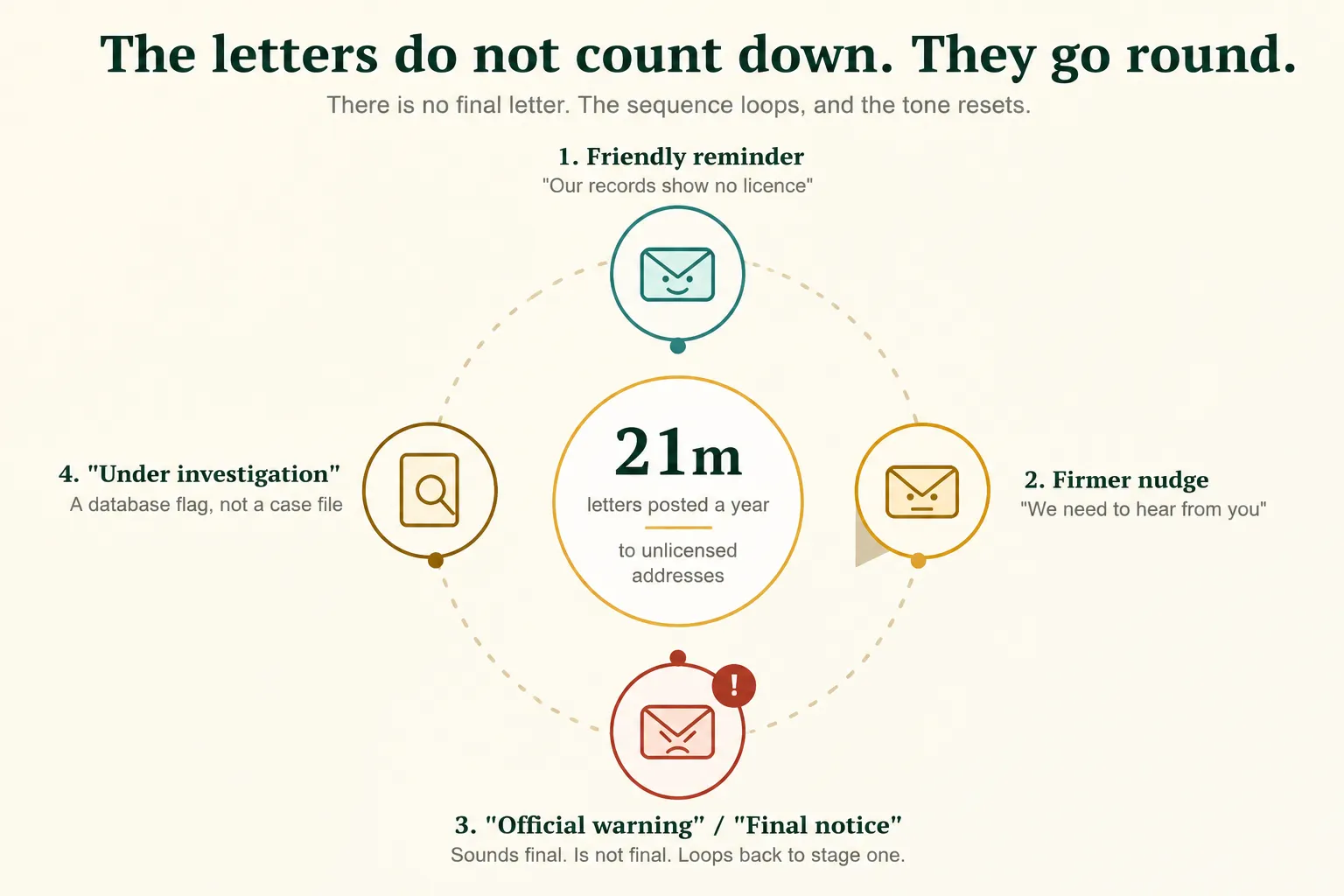
“Our records show no licence at this address”
This is the opening letter and it is the most honest one in the whole sequence. It states a plain fact: there is no licence registered to your address. It is correct, and it is not accusing you of anything. If you do not need a licence, this is the natural moment to say so with a declaration. If you do need one, this is your cheapest possible exit, because nothing has escalated yet.
“We need to hear from you”
A nudge letter. It usually carries a soft deadline and asks you to confirm your situation. There is no penalty attached to that deadline, and nothing happens on the day it passes. It exists to create a sense of obligation and to prompt a reply. You are not legally required to give one.
“Your address is under investigation”
This wording alarms people more than any other, and it is worth being precise about what it means. In TV Licensing’s language, an investigation usually just means your address has been flagged as unlicensed and is now eligible for an officer visit. It does not mean a case file has been opened, that a court is involved, or that anyone is building evidence against you. It is a status in a database, not a legal process.
“Official warning” or “Final notice”
The heaviest of the standard licence letters, and the one that most often prompts people to pay. Despite the wording, it is not final in any legal sense, and it is not a warning in the way a court would use that word. Plenty of people receive letters headed as final notices repeatedly, for years, because the sequence loops back and starts again. There is no legal step that automatically follows this letter.
“Your address has been scheduled for a visit”
This one is partly true and partly theatre. Your address may genuinely be added to a visiting officer’s list. What the letter does not tell you is that officers make around four million visits a year across the whole country, that they cannot enter your home without permission or a warrant, and that being on a list is not the same as an appointment. Many people receive this letter for years without anyone ever knocking.
“We know you have been watching BBC iPlayer”
This appears in some letters and emails, and it needs care. TV Licensing can, in some circumstances, link iPlayer sign-ins to an address, because iPlayer asks for a postcode when you register an account. If someone in your household has signed into iPlayer using your address, this claim may be accurate, and iPlayer use does require a licence, even for catch-up. If nobody at your address has ever used iPlayer, treat the claim with scepticism, because the same wording gets sent speculatively.
TV Licence Letter vs Court Notice
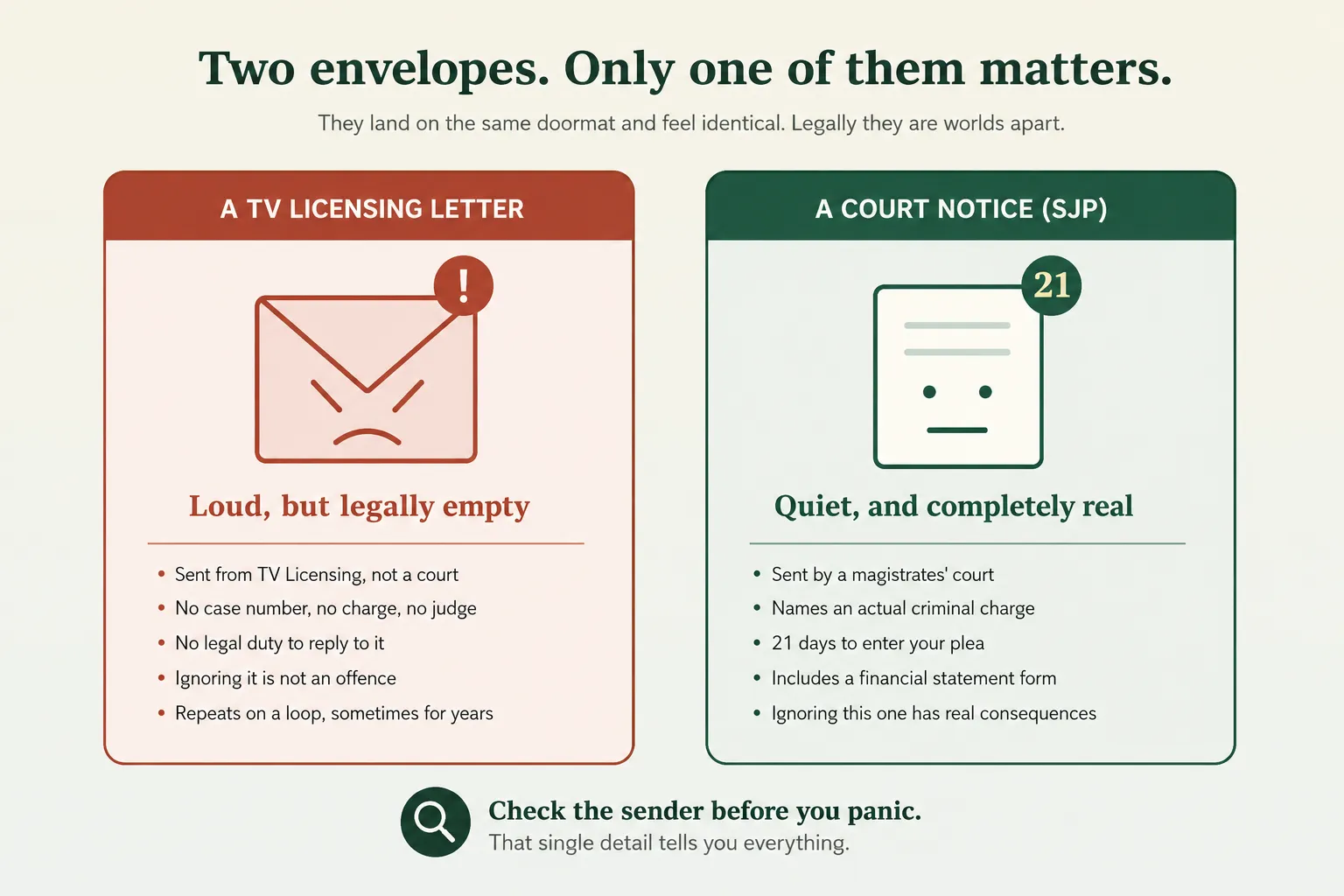
Everything above is a TV Licensing letter. None of it comes from a court. There is exactly one piece of post in this whole story that carries real legal weight, and it looks nothing like the others.
A TV Licensing letter
A Single Justice Procedure notice
If you take one thing from this page, make it that distinction. Ignoring TV licence letters carries no penalty. Ignoring a court notice means a magistrate decides your case without ever hearing from you, which is exactly how most people end up convicted in their absence. The two look and feel similar when they land on your doormat, and they could not be more different in what they do. Our guide to TV licence enforcement covers the court stage in full.
What Happens If You Ignore TV Licence Letters
Nothing happens on its own. There is no automatic fine, no automatic court case, and no automatic anything. Ignoring TV licence letters is not an offence, and the letters themselves have no mechanism to turn into a penalty. This is the single most misunderstood point in the whole subject.
What does happen is simpler and slower. The letters keep arriving, roughly every few weeks, cycling through the tones and then starting again. Because you have never told TV Licensing anything about your situation, your address stays flagged as unlicensed, which keeps it eligible for a visit from an enforcement officer. That visit may never come. If it does, you are not obliged to let the officer in or to answer questions, and no offence is committed by declining either.
The honest picture is this. If you genuinely do not need a licence, ignoring the letters costs you nothing legally, but it does mean living with a steady drip of alarming post indefinitely. If you do need a TV licence, ignoring the letters does not make the requirement disappear, and the eventual cost of a prosecution is far higher than the licence fee itself. Ignoring letters is a reasonable choice in the first case and a poor one in the second.
Do You Have to Reply?
No. There is no legal duty to reply to a TV licence letter, no duty to confirm whether you need a licence, and no penalty for staying silent. These are requests dressed in official language, and a request is all they are.
That said, replying has one practical use. If you genuinely do not need a licence, telling TV Licensing so through the formal declaration is the only thing that reduces the volume of letters. Silence keeps you flagged forever. There is a live disagreement online about whether it is wiser to declare or to stay entirely silent, and it is worth understanding both views honestly rather than pretending there is a single right answer.
The case for declaring
The case for staying silent
For most people who genuinely do not need a licence, declaring is the more practical option, because it actually reduces the letters and costs nothing. If you prefer not to engage, that is your right, and you are not breaking any law by choosing it.
How to Stop TV Licence Letters
There are only two ways, and which one applies depends entirely on whether you need a licence.
If you do not need a licence: make a declaration
Complete the No Licence Needed declaration on the official TV Licensing website. It is free, takes a few minutes, and pauses standard letters for two years. Set a reminder to renew it when the two years are up, because the letters restart automatically otherwise.
If you do need a licence: buy one
If anyone at your address watches live television on any channel, or uses BBC iPlayer at all, a licence is required and the letters will not stop until you have one. At £180 a year, it costs considerably less than the fine and conviction that a prosecution can bring.
Writing back to argue, returning TV licence letters to sender, or writing “no licence needed” on the envelope does not stop anything, because the letters are generated by a database rather than read by a person. The declaration is the only message the system actually recognises.
How to Spot a Fake TV Licence Letter or Email
Because the real letters are alarming and demand urgent action, they are perfect cover for scammers, and fake TV Licensing emails are common. The genuine letters have some reliable markers.
Signs it is genuine
Signs it is a scam
If a message asks for payment details or a refund, treat it as a scam until proven otherwise. If you want to check whether a letter is real, do not use any phone number or link printed on it. Go to the official website directly and use the contact details there.
Frequently Asked Questions
Do I have to reply to TV licence letters?
No. There is no legal duty to reply to a TV licence letter, and no penalty for leaving one unanswered. The letters are requests, not court documents. The one thing that does change if you never reply is that TV Licensing has no record of your situation, so the letters keep coming and an officer may eventually visit.
What happens if you ignore TV licence letters?
Nothing happens automatically. Ignoring TV letters is not an offence and no fine follows from it. The letters simply continue and escalate in tone, and eventually an enforcement officer may call at your address. Ignoring a letter is very different from ignoring a court notice, which does carry real consequences.
How do I stop TV licence letters?
If you genuinely do not need a licence, complete the No Licence Needed declaration on the TV Licensing website. This pauses the standard letters for two years, after which you renew it. If you do need a licence, the only way to stop the letters is to buy one.
Are TV licence threatening letters real?
The letters are usually genuine, but the threats in them are softer than they sound. Phrases like investigation opened or visit authorised are standard automated wording sent to millions of addresses. They do not mean a case has been opened against you personally or that a court is involved.
How many TV licence letters do you get before a visit?
There is no fixed number. Many people receive the same cycle of letters for years without ever being visited. Others are visited sooner. The letters repeat on a loop rather than counting down to a specific event.
Is a TV licence warning letter a fine?
No. A warning letter is not a fine, a summons, or any kind of legal penalty. Only a magistrates’ court can impose a fine, and that only happens after a formal prosecution notice, which looks completely different from a TV Licensing letter.