Quick answer: the TV licence blind concession halves the fee to £90 a year for anyone registered as severely sight impaired, at any age. Partial sight or sight impairment on its own does not qualify. You apply with evidence such as a CVI, a local authority letter, or an ophthalmologist’s certificate, and the discount covers everyone living at your address.
Thousands of eligible households pay full price for their TV licence simply because nobody told them a TV licence blind concession existed, or their application was rejected over evidence that was never explained properly. The confusion is understandable: severely sight impaired and partially sighted sound similar but qualify completely differently, and the accepted proof goes well beyond the certificate most people assume is the only option. This article clears up exactly who qualifies, what evidence genuinely counts, and how to apply without the delay a rejected first attempt causes
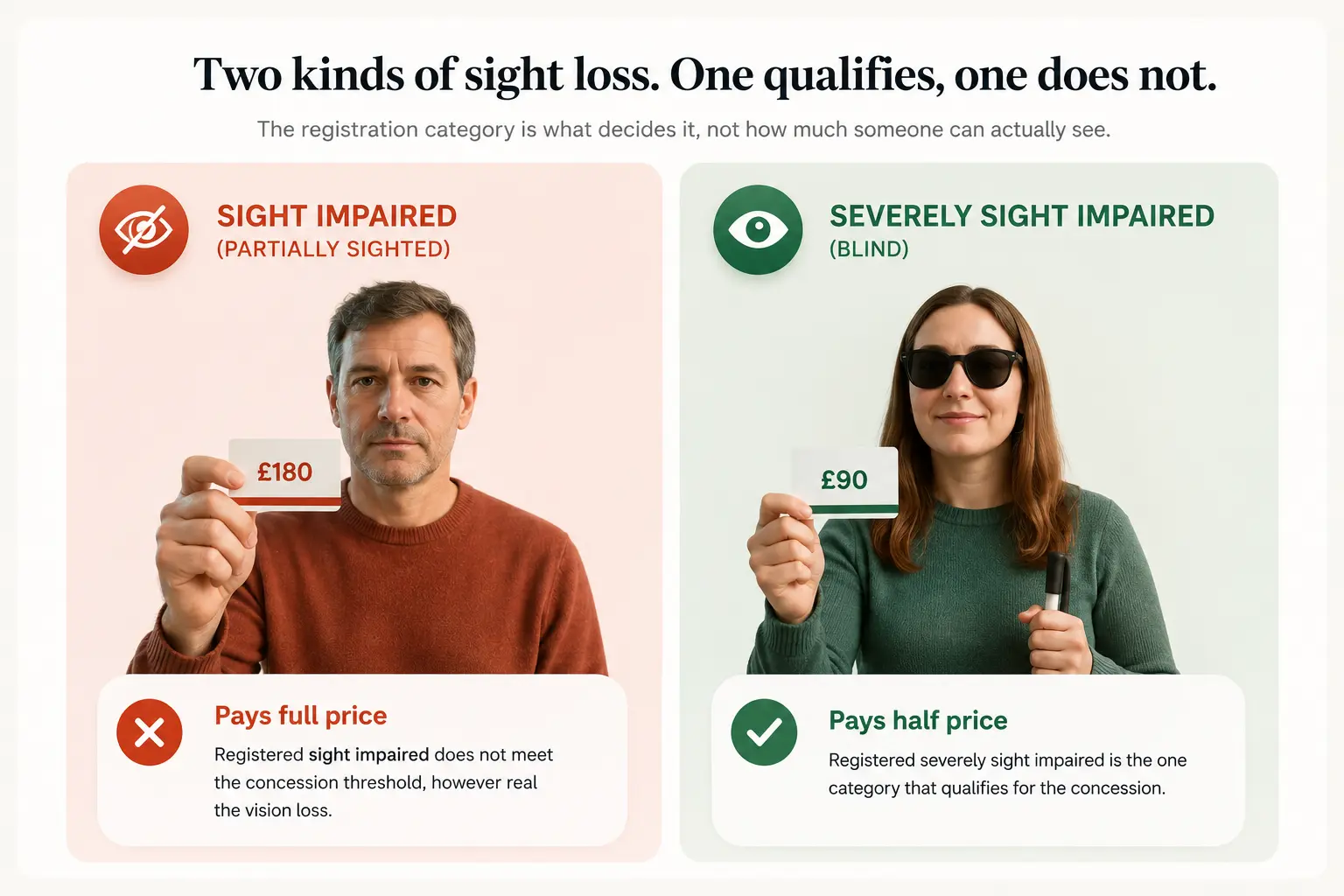
Severely Sight Impaired, Not Partially Sighted
This is the distinction that decides everything, and it catches out more applicants than any other part of the process. The concession is only available to people registered as severely sight impaired, the term that replaced registered blind. If you are registered as sight impaired, sometimes called partially sighted, you do not qualify, regardless of how significant your vision loss actually is day to day. This can feel unfair given how much sight impairment varies within each category, but the rule is drawn at that specific registration line, not at a general assessment of how well someone can see.
There is no minimum age. A child registered severely sight impaired qualifies exactly the same as an adult, with the application made in the child’s name and their own medical evidence attached. This is best understood as a blind discount TV licence rather than a separate product: it is the same licence, reduced by half.
What a Blind Concession TV Licence Actually Costs
|
Licence type |
Standard rate |
Blind concession rate |
|
Colour licence |
£180.00 |
£90.00 |
|
Black and white licence |
£60.50 |
£30.25 |
The concession is a flat 50% reduction, so it moves automatically if the standard fee changes each April.
A TV licence for blind customers has worked this way since the concession was introduced, and the 50% structure has remained consistent even as the underlying standard fee has risen.
The Evidence Question, Answered Properly
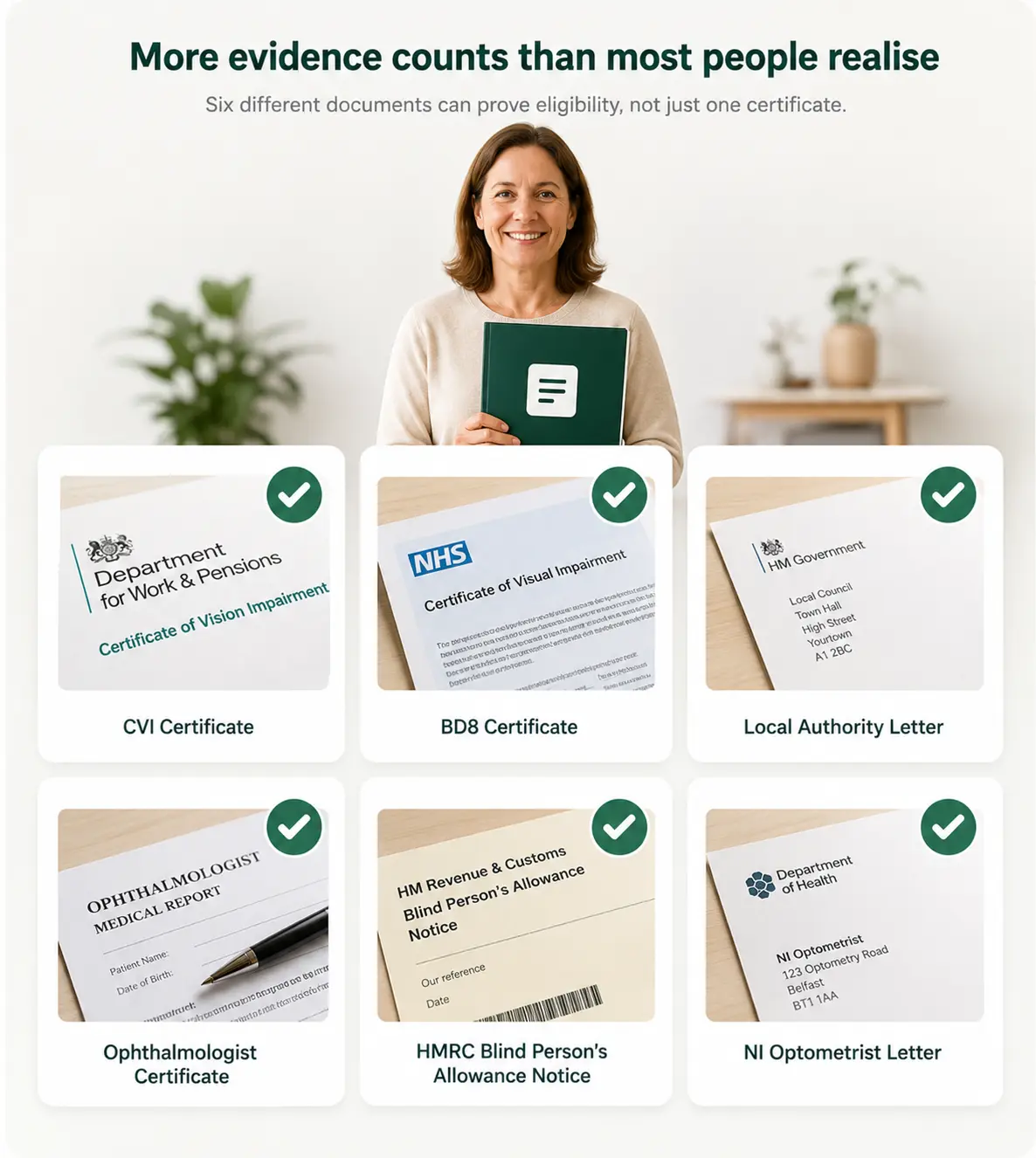
Most rejected applications come down to evidence, either the wrong document or none attached at all. TV Licensing accepts a wider range of proof than most people realise, and it is worth knowing the full list before you apply rather than guessing at one option and being turned away.
Accepted evidence
Not accepted on its own
The HMRC route surprises most people, since documentation for one benefit rarely gets connected to a completely separate discount like this one, and it is easy to overlook. If you already receive Blind Person’s Allowance, the tax coding notice HMRC sends confirming this is accepted as standalone proof, which means some applicants already hold valid evidence sitting in a drawer without realising it qualifies them. Always send a copy rather than the original, since TV Licensing only needs to see a copy and there is a genuine risk of losing an irreplaceable original in the post.
Northern Ireland Has Its Own Route
If you live in Northern Ireland, a letter from your community optometrist confirming you meet the criteria for Certification of Severe Sight Impairment is accepted as evidence, an arrangement introduced specifically to make the concession easier to access without needing a separate hospital-based certificate. This followed campaigning by RNIB and is currently specific to Northern Ireland, though there has been discussion of extending a similar route more widely across the UK. If you live in the Isle of Man, DHSS documentation confirming your registration serves the same purpose locally, reflecting the fact that evidence routes are not entirely uniform across every part of the UK and its nearby territories.
How to Apply for the Blind Concession?
Gather your evidence first
Have a copy of whichever accepted document applies to you ready before you start the form, rather than starting the application and searching for it afterwards.
Complete the application in the right name
The application must be made in the name of the person who is severely sight-impaired, not by a family member arranging it on their behalf, even if that person fills in the form.
Attach your evidence
Submit a copy alongside the application, whether applying online or by post. Applications without evidence attached are not processed.
Wait for confirmation
Once your evidence is verified, your licence is set up or renewed at the concession rate, and covers your whole household from that point.
Postal applications go to: Blind Concession Group, TV Licensing, Darlington DL98 1TL. The application form and correspondence are also available in Welsh, Braille, large print, and audio on request.
If the Licence Is Not Already in the Right Name
A common situation is a household where someone becomes severely sight impaired, or moves in, but the existing TV licence is registered to a different person at the address. This does not need a separate transfer request. Making a first-time blind application in the correct name, using the existing licence number for that address, moves the licence into the right name and applies the concession in one step, rather than two.
Who Else in the Household Is Covered?
Once the concession licence is set up, it covers everyone living at that address, just like a standard licence does, not just the person who is severely sight-impaired. There is no need to register other household members separately or notify TV Licensing of who else lives there. This includes lodgers, adult children, and anyone else sharing the property, as long as it remains one household under a single licence rather than separate tenancies with their own facilities.
Can You Get the Blind Concession and the Over-75 Free Licence Together?
If someone at your address is 75 or over and receives Pension Credit, that free licence takes priority over the blind concession, since free is a larger saving than half price. The blind concession is most relevant for households where nobody meets the over-75 and Pension Credit criteria, but someone is registered severely sight impaired, at any age. Full details on the free over-75 route, including the household rule and how to apply, are covered in our TV licence over 75 guide.
Mistakes That Delay Applications
Applying in the wrong name
The concession applies to the severely sight-impaired person specifically. Applying in a carer or family member’s name instead means the application does not qualify.
Sending sight impairment evidence, not severe sight impairment
Documents confirming partial sight or general sight impairment do not meet the threshold, even when vision loss is genuinely significant.
Forgetting to attach evidence at all
An application submitted without proof simply is not processed, which delays things further than sending it correctly the first time.
Sending an original document
Always send a copy. TV Licensing does not need the original, and postal loss is a real risk worth avoiding.
Frequently Asked Questions
How much is a TV licence for a blind person?
It costs £90 a year for a colour licence, half the standard £180 rate, or £30.25 for a black and white licence. The concession applies to anyone registered as severely sight impaired, regardless of age.
Do partially sighted people qualify for the TV licence blind concession?
No. Only people registered as severely sight impaired, previously called registered blind, qualify for the concession. Being registered as sight impaired or partially sighted does not meet the criteria, however significant the vision loss.
What evidence do I need to apply for blind TV licence concession?
TV Licensing accepts several forms of proof, including a Certificate of Visual Impairment, a BD8 certificate, a letter from your local authority confirming your registration, a certificate from an ophthalmologist, or an HMRC tax coding notice showing you receive Blind Person’s Allowance.
Can I apply for the blind concession if the licence is not in my name?
Yes. If the existing licence at your address is not registered to the person who is severely sight impaired, you make a first-time blind application in their name and enter the existing licence number, which transfers it automatically.
Does the blind concession cover other people in the household?
Yes. Once the licence is registered in the name of the severely sight-impaired person, it covers everyone living at that address, just as a standard licence does.
Can you get the blind concession and the over-75 free licence together?
If someone qualifies for the free over-75 licence through Pension Credit, that takes priority, and the licence is free rather than half price. The blind concession applies when someone does not qualify for the free over-75 licence but is registered as severely sight-impaired.