A standard colour TV licence costs £180 a year from 1 April 2026. That works out at £15 a month if you pay by direct debit. This is the price for every household in the UK, whether you live alone or share a house with five other people, and it covers every television, laptop, tablet and phone at your address.
This page breaks the fee down properly: the exact cost per month and per year, why it went up this April, what it will probably cost next year, and every discount that actually exists, including the ones most people never hear about. We update these figures every time the government announces a change, usually in February each year.
What It Costs You
|
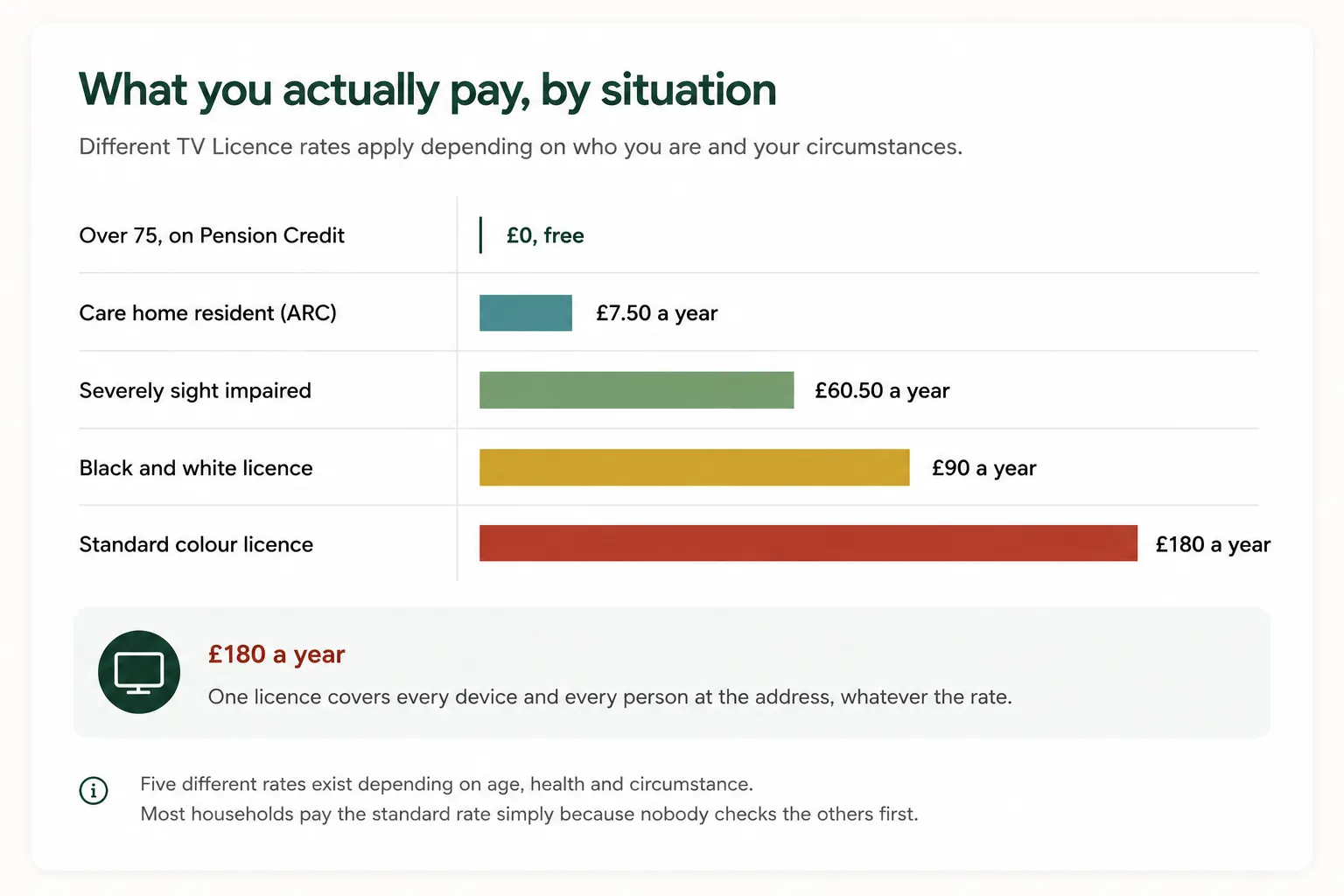
Licence type |
Cost per year |
Cost per month (direct debit) |
|
Colour licence (standard) |
£180.00 |
£15.00 |
|
Black and white licence |
£60.50 |
£5.04 |
|
Blind concession (50% off colour) |
£90.00 |
£7.50 |
|
Care home ARC licence |
£7.50 |
Paid annually only |
|
Over 75 on Pension Credit |
Free |
Free |
Prices apply from 1 April 2026. A black and white licence is genuinely still a thing, mostly bought by people restoring old sets. Fewer than 4,000 households in the whole of the UK hold one.
How Much Is a TV Licence Per Month?
If you pay by monthly direct debit, a colour licence works out at exactly £15.00 a month once your payments have settled into a normal rhythm. There is a quirk in year one that catches a lot of new payers off guard, so it is worth knowing before you set up the direct debit rather than after your first payment lands.
When you first set up monthly payments, TV Licensing needs to get you to a full year of cover in six instalments rather than twelve, because your licence is valid from day one even though you are still paying it off. In practice this means your first six monthly payments are roughly double the standard rate, close to £30 a month, before dropping to the normal £15 a month from month seven onward. Nobody explains this clearly at sign up, and it is the single most common reason people think they have been charged the wrong amount.
After that first year, every renewal simply continues at £15 a month with no catch up required, because you are now paying a year in advance the way the direct debit was always meant to work.
Quarterly direct debit costs more, not less
TV Licensing also offers quarterly direct debit, and this is the option to avoid. Paying quarterly adds a small premium to each instalment, roughly £1.25 extra per payment compared with the equivalent monthly amount, which adds up to about £5 more over the year for exactly the same licence. There is no practical benefit to paying quarterly instead of monthly, since both are automatic and both spread the cost. If you are already on quarterly payments, switching to monthly through your TV Licensing online account takes a few minutes and saves you that £5 every year going forward.
Paying weekly or fortnightly with a card
If direct debit is not for you, TV Licensing issues a free payment card that lets you pay in cash at any PayPoint outlet, on whatever schedule suits you: weekly, fortnightly or monthly. You can no longer pay for a Television licence at the Post Office, which surprises people who have paid that way for years. The payment card is now the cash equivalent, and there is no extra charge for using it compared with the standard annual price, as long as you clear the full year within the twelve months.
How Much Is a TV Licence Per Year?
Paying annually costs exactly £180.00 in one payment, by debit card, credit card, direct debit or cheque. There is no discount and no penalty for paying this way compared with monthly instalments. It simply means the whole cost leaves your account at once rather than being spread out.
One thing genuinely worth knowing if you are due to buy or renew around the end of March: your licence charges whatever the rate is on the day it starts, and that rate is locked in for the full twelve months you are paying for. If you buy or renew in the last week of March, before the new financial year’s price takes effect on 1 April, you lock in the previous year’s price for an entire year. It is a small saving, usually £5 to £6, but it costs nothing to do and simply means paying a few days earlier than you otherwise would.
If you are already on a payment card or a quarterly or weekly schedule when a price rise happens, you keep paying toward your current licence at the old rate until that licence is due for renewal. The higher price only applies once your licence actually renews on or after 1 April, not retroactively to payments already in progress.
Why the Fee Went Up, and What Happens Next
The government decides the price, not the BBC. Since April 2024, the rule has been simple: the licence fee rises every April in line with the Consumer Prices Index, the same inflation measure used across most of the economy. The figure used each year is the average CPI reading across the twelve months to that September, announced by the government the following February.
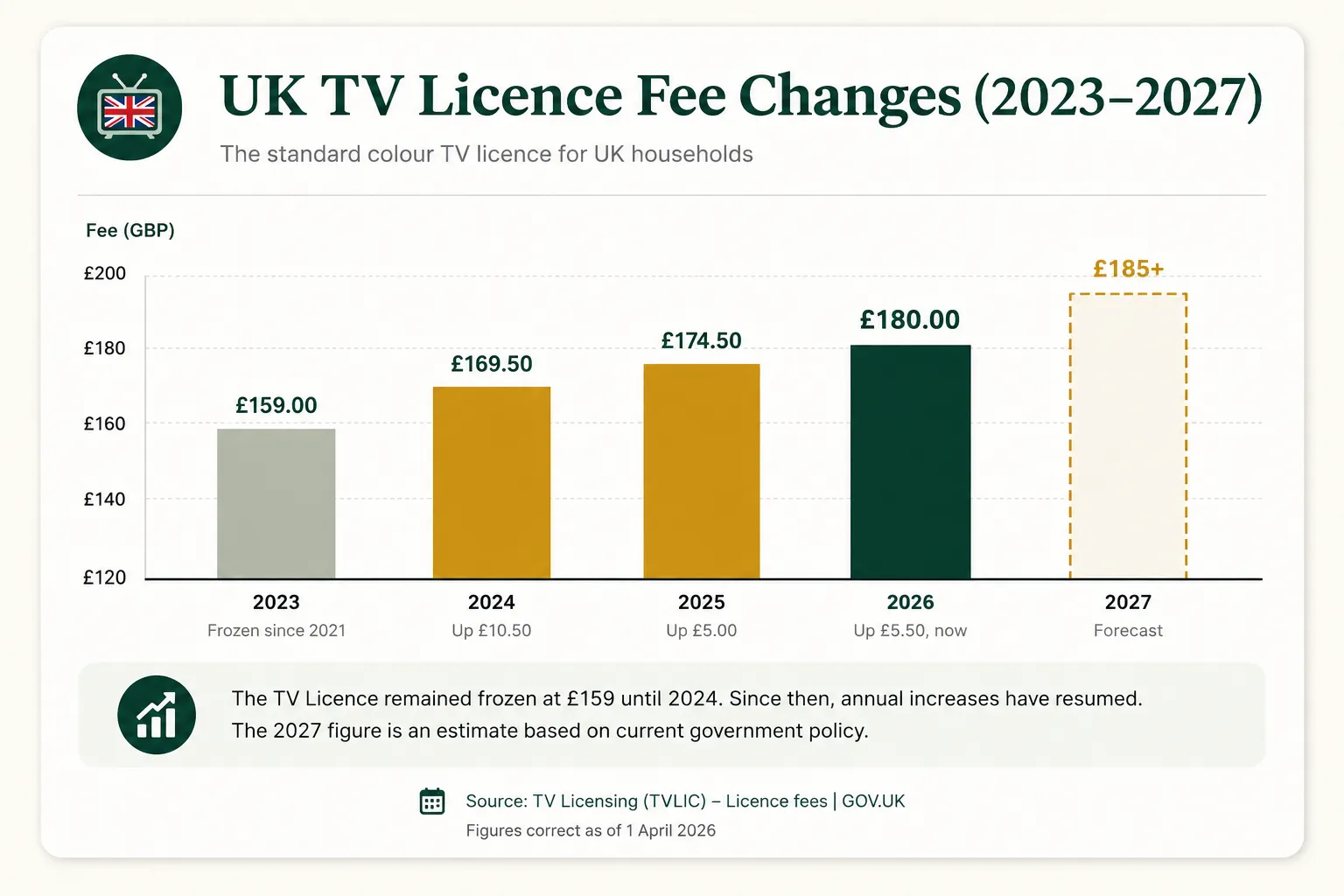
For 2026, that calculation produced a 3.15% rise, which took the fee from £174.50 to £180.00, a jump of £5.50. The year before, the rise was smaller, just £5.00, taking the price from £169.50 to £174.50. Before that, the fee had actually been frozen at £159.00 for three straight years between 2021 and 2024, part of an earlier funding settlement that held the price flat while inflation elsewhere kept climbing.
This inflation link is locked in for the rest of the current BBC Charter period, which runs until 31 December 2027. That means a further rise is already guaranteed for April 2027, calculated the same way from the CPI figure for the year to September 2026. Nobody can say the exact number yet since it depends on inflation between now and then, but based on current forecasts a figure somewhere around £185 to £190 is a reasonable expectation, not a certainty.
What happens after that is genuinely open. A new BBC Charter takes effect from 1 January 2028, and the government has been running a public consultation through 2026 on how the BBC should be funded from that point onward. The options on the table include keeping a version of the current licence fee, moving to a household charge similar to schemes used in Germany, funding some or all of the BBC through general taxation as several other European countries do, introducing subscription tiers for services like iPlayer, or some mixture of these. A formal white paper setting out the government’s preferred direction is expected later in 2026, well before any change would actually take effect. Nothing changes for how you pay between now and the end of 2027 regardless of how that debate goes.
How Much Is a TV Licence for Pensioners?
This is where the most expensive misunderstanding in the whole system lives, so it deserves a proper answer for TV licence cost for pensioners rather than a one line summary.
Being a pensioner on its own does not reduce the fee at all. If you are 60, 70, or even 74, you pay the full £180 a year exactly like everyone else, unless you separately qualify for one of the discounts below on other grounds, such as being severely sight impaired. There is no general seniors’ discount and never has been one at that threshold.
The one genuine exemption is for households where someone is 75 or over and receiving Pension Credit. If that applies to you, your licence is entirely free, and it covers everyone else living at your address regardless of their own age. This scheme replaced the old system in August 2020, which had given every such household a free licence regardless of income. That blanket exemption is gone and has been for six years now, but plenty of people still believe it exists, and some are paying £180 a year they do not need to.
You likely qualify if
You do not qualify if
Around 800,000 pensioners who are entitled to Pension Credit have never claimed it, according to government figures, and every one of them is also missing out on the free TV licence that comes with it. Pension Credit itself is worth checking regardless of this, since it can lead to other help too, including Council Tax reduction, help with NHS costs, and Cold Weather Payments. For the 2026/27 year, Pension Credit tops your weekly income up to £238.00 if you are single or £363.25 if you are a couple, so even a small shortfall against those figures can mean you qualify. You can check for free through the government’s Pension Credit calculator or by calling the Department for Work and Pensions on 0800 99 1234.
If you have been paying full price and later discover you qualify, you are not stuck having wasted that money. You can apply for a refund covering the period you were eligible, on top of moving onto the free licence going forward.
Blind and Severely Sight Impaired Discount
If you or someone in your household is registered as severely sight impaired, formerly called registered blind, you can apply for a licence at half price: £90.00 a year instead of £180.00. The application needs to be in the name of the person who is registered, but once approved it covers everyone living at that address, the same as a standard licence does.
To apply, you need evidence: either a copy of your certificate of vision impairment, sometimes still called a CVI, or a letter from a local authority confirming your registration, or a certificate from an ophthalmologist. Partial sight impairment does not qualify for this discount. It is specifically for the severely sight impaired category.
Care Home and Sheltered Housing Discount
Residents of qualifying residential care homes, sheltered housing, or almshouses can get what is called an Accommodation for Residential Care licence, or ARC licence, for just £7.50 a year, covering their own room. To qualify, the resident generally needs to be over 60 and retired, or living with a disability, and the accommodation itself has to be registered as eligible. This is not something you apply for yourself. Your warden, scheme manager, or the home’s administrator handles the application on your behalf, since it is tied to the accommodation as much as to the individual resident.
It is worth asking directly if you are not sure whether your accommodation qualifies, since this discount is easy to miss if nobody mentions it to you.
Is There a Low Income Discount?
No, and this catches a lot of people out. Unlike Council Tax, energy bills, or broadband, there is no general reduced rate for households on a low income, on benefits, or claiming Universal Credit. The only discounts that exist are the specific ones covered above: the over 75 Pension Credit exemption, the blind concession, and the care home rate. If none of those apply to your household, the fee is £180 regardless of income.
What does exist for anyone struggling to pay is the Simple Payment Plan, run directly by TV Licensing. It does not reduce the total amount owed, but it spreads the £180 into smaller weekly or fortnightly instalments than the standard options allow, at no extra cost. In 2025 the government expanded this scheme to cover an additional 9,000 households on a case by case basis. You cannot simply sign yourself up online. You need to be referred, either by TV Licensing directly after contacting them about payment difficulty, or through a debt advice charity such as Citizens Advice or StepChange, who can refer you in.
TV Licences for Businesses
A TV licence is not just a household cost. Any business premises where staff or customers might watch live television or use BBC iPlayer needs one too, and the price is exactly the same as for a home: £180 a year for a colour licence. This includes staff rooms, waiting areas, and shop floors with a television playing.
Hotels, guest houses, and similar overnight accommodation get a more generous arrangement. A single licence covers up to 15 guest rooms or accommodation units, meaning a 30 room hotel would need two licences, not thirty. Larger venues need to work out their exact requirement based on room count, and TV Licensing’s business team can advise on unusual setups such as holiday parks or serviced apartments.
Six Ways to Pay Less Without Breaking Any Rules
Check Pension Credit eligibility
If anyone in your home is 75 or approaching it, checking Pension Credit eligibility could turn £180 a year into £0. Many pensioners who qualify have simply never applied.
Switch off quarterly direct debit
Move to monthly direct debit instead and save roughly £5 a year for identical cover, since quarterly carries a small built in premium.
Renew in late March
Buying or renewing just before 1 April locks in that year’s price for a full twelve months, avoiding the April rise for one more year.
Apply for the blind concession
If you or someone in your household is severely sight impaired but has never applied, half the licence fee is sitting unclaimed.
Ask about the Simple Payment Plan
If the cost is a genuine strain, this spreads payment without adding anything to the total, unlike some other bill payment plans.
Check if you need one at all
If your household only streams on demand content and never touches iPlayer, the honest answer might be that you owe nothing. Use the licence checker to confirm.
Frequently Asked Questions
How much is a TV licence a year?
A standard colour licence costs £180 a year from 1 April 2026. A black and white licence costs £60.50 a year, and a severely sight impaired concession costs £90 a year.
How much is a TV licence per month?
£15 a month by direct debit, once your account has settled into its normal pattern. In the first year, expect roughly six higher payments of about £30 while you catch up to a full year of cover, before it drops to £15 a month.
How much is a TV licence for pensioners?
The same £180 as everyone else, unless someone in the household is 75 or over and receives Pension Credit, in which case the licence is completely free. There is no discount for pensioners under 75, or for pensioners over 75 who do not receive Pension Credit.
Is the TV licence going up in 2027?
Yes, almost certainly. The government has committed to raising the fee each April with inflation until the current BBC Charter ends in December 2027. The exact figure is confirmed each February, and early estimates suggest somewhere around £185 to £190, though nothing is fixed yet.
Do you pay a TV licence if you only watch Netflix?
No. If your household only watches on demand content on Netflix or similar services, and never watches live television or BBC iPlayer on any device, you do not need a licence and owe nothing.
Why has my TV licence gone up?
The government sets the fee to rise every April in line with the Consumer Prices Index, the standard measure of inflation. This has applied every year since April 2024 and continues until the current BBC Charter ends in December 2027.
Is there a discount for low income households?
There is no general low income discount. The only reductions available are for over 75s on Pension Credit, severely sight impaired viewers, and qualifying care home residents. Anyone struggling to pay can ask about the Simple Payment Plan, which spreads the cost without reducing it.
How much does a TV licence cost for a business?
The same £180 a year as a home licence. Hotels and similar accommodation get one licence per 15 guest rooms rather than needing a separate licence for every room.